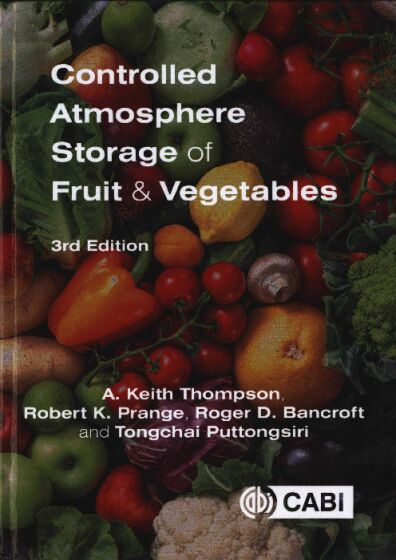
书名:Controlled atmosphere storage of fruit and vegetables
责任者:A. K. Thompson | R.K. Prange | R.D. Bancroft | Tongchai Puttongsiri | Robert K. Prange | Roger D. Bancroft | Tongchai Puttongsiri.
分类号:农业科学
版次:3rd ed.
页数:xxiii, 420 pages :
前言
The name ‘controlled atmosphere storage’ replaced the archaic term ‘gas storage’ and is synonymous with the term ‘modified atmosphere storage’, though the latter is little used and usually only specifically in modified atmosphere packaging. Modified atmosphere packaging refers to using packaging material (usually plastic film) that is partially permeable to gases and that uses the metabolism of the product it contains to change the atmosphere to one that is more beneficial for storage. Another way of changing the atmosphere is to coat the individual fruit or vegetable in such a way that gas exchange is restricted, resulting in a more beneficial atmosphere in the cells and intercellular spaces.
For almost a century an enormous volume of literature has been published on the subject of controlled atmosphere storage of fresh fruits and vegetables. It would be the work of a lifetime to begin to do those results justice in presenting a comprehensive and focused view, interpretation and digest for its application in commercial practice. Such a review is in demand to enable those engaged in the commerce of fruits and vegetables to be able to utilize this technology and reap its benefits in terms of the reduction of postharvest losses and maintenance of their nutritive value and organoleptic characteristics. The potential use of controlled atmosphere storage as an alternative to the application of preservation and pesticide chemicals is of continuing interest.
In order to facilitate the task of reviewing the literature we have had to rely on a combination of reviewing original publications as well as consulting reviews and technical books. The latter are not always entirely satisfactory, since they may not give their source of information and we may have inadvertently quoted the same work more than once. Much reliance has been made on conference proceedings, especially the International Controlled Atmosphere Research Conference held every few years, the European Co-operation in the Field of Scientific and Technical Research (COST 94) which held postharvest meetings throughout Europe between 1992 and 1995, the International Society for Horticultural Science’s regular international conferences and the CAB Abstracts.
Different views exist on the usefulness of controlled atmosphere storage. Blythman (1996) described controlled atmosphere storage as a system that ‘amounts to deception’ from the consumer’s point of view. The reason behind this assertion seems to be that the consumer thinks that the fruits and vegetables that they purchase are fresh and that controlled atmosphere storage technology ‘bestows a counterfeit freshness’. Also she claimed that storage may change produce in a detrimental way and cited changes in texture of apples, ‘potatoes that seem watery and fall apart when cooked and bananas that have no flavour’. Some of these contentions are true and need addressing, but others are oversimplifications of the facts. Another view was expressed by David Sainsbury in 1995 and reported in the press as: ‘These techniques [controlled atmosphere storage], could halve the cost of fruit to the customer. It also extends the season of availability, making good eating-quality fruit available for extended periods at reasonable costs.’
The purpose of this book is primarily to help the fresh produce industry in storage and transport of fruit and vegetables, but it also provides an easily accessible reference source for those studying agriculture, horticulture, food science and technology and food marketing. In addition it will be useful to researchers in this area, giving an overview of our present knowledge of controlled atmosphere storage that will indicate areas where there is a need for further research.
查看更多
目录
About the Authors xi
Preface xiii
Acknowledgements xv
Glossary xvii
Units of Measurement xix
Abbreviations xxi
1 Introduction 1
History of the Effects of Gases on Crops 1
2 Harvest and Pre-harvest Factors 14
Organic Production 15
Fertilizers 15
Climate and Weather 16
Fungicides 16
Water Relation 18
Harvest Maturity 19
Chemical Sprays 21
3 Effects and Interactions 25
Carbon Dioxide and Oxygen Damage 26
High Oxygen Storage 31
Carbon Dioxide Shock Treatment 32
Total Nitrogen or High Nitrogen Storage 33
Ethylene 34
Carbon Monoxide 36
Temperature 36
Humidity 36
Delayed CA Storage 37
Interrupted CA Storage 38
Residual Effects of CA Storage 38
4 Quality 40
Flavour 40
Volatile Compounds 43
Acidity 44
Nutrition 45
5 Physiology, Ripening and Genetics 50
Respiration Rate 50
Fruit Ripening 55
Genetics 58
6 Pests, Diseases and Disorders 64
Physiological Disorders 64
Fungal Diseases 70
Bacterial Diseases 71
Insects 72
7 Pre-storage Treatments 75
High Temperature 75
Irradiation 78
Hydrogen 78
Waxing and Polishing 79
Carboxymethyl Cellulose 80
Starch 82
Carrageenan 83
Chitosan 83
Essential Oils 83
Alginate 84
Salicylic Acid 85
Trehalose 85
Gum Arabic 86
Zein 86
Methyl Jasmonate 87
Gibberellins 87
Bacteria 88
Daminozide 88
1-Methylcyclopropene 88
8 CA Technology 103
Temperature Control 107
Humidity Control 108
Gas Control Equipment 109
Plastic Tents and Membranes 115
Ripening Rooms 119
Modelling 122
Safety 123
9 Dynamic CA Storage 125
History of DCA 125
Respiratory Quotient 127
Ethanol 131
Chlorophyll Fluorescence 133
Comparison of Ethanol, RQ and CF Systems 135
Current Situation 139
Future Trends 141
10 Hyperbaric and High-oxygen Storage 143
Technology 144
Effects of High Pressure 144
Effects on Selected Crops 150
11 Hypobaric and Low-oxygen Storage 153
Technology 155
Adding Carbon Dioxide 158
Pre-storage Treatments 159
Effects on Physiology, Quality and Deterioration 159
Effects on Selected Crops 163
12 Recommended CA Conditions 178
Apple 178
Apricot 190
Apricot, Japanese 191
Artichoke, Globe 191
Artichoke, Jerusalem 192
Asian Pear, Nashi 192
Asparagus 192
Aubergine, Eggplant 193
Avocado 193
Banana 195
Basil 196
Bayberry, Chinese 197
Beans, Runner 197
Beet 197
Blackberry 197
Blackcurrant 198
Blueberry, Bilberry, Whortleberry 198
Breadfruit 199
Broccoli, Sprouting 199
Brussels Sprouts 201
Butter Bean, Lima Bean 202
Cabbage 202
Cactus Pear, Prickly Pear, Tuna, Opuntia 204
Capsicum, Sweet Pepper, Bell Pepper 204
Carambola, Star Fruit 205
Carrot 205
Cassava, Tapioca, Manioc, Yuca 205
Cauliflower 205
Celeriac, Turnip-rooted Celery 206
Celery 207
Cherimoya 208
Cherry, Sour 208
Cherry, Sweet 208
Chestnut, Chinese 210
Chestnut, Sweet 210
Chicory, Endive, Belgian Endive, Escarole, Radicchio, Witloof Chicory 211
Chillies 211
Chinese Cabbage 211
Citrus Hybrids 212
Cranberry 212
Cucumber 212
Durian 213
Feijoa 213
Fig 213
Garlic 214
Gooseberry 214
Grape 215
Grapefruit, Pummelo 216
Guava 216
Horseradish 217
Jujube 217
Kiwifruit 217
Kohlrabi 218
Lanzones, Langsat 218
Leek 218
Lemon 219
Lettuce 219
Lime 219
Litchi, Lychee 219
Mamey 220
Mandarin, Satsuma 220
Mango 221
Mangosteen 224
Medlar 225
Melon 225
Melon, Bitter 225
Mushroom 225
Mushroom, Cardoncello 226
Mushroom, Oyster 226
Mushroom, Shiitake 226
Natsudaidai 226
Nectarine 227
Okra 227
Olive 228
Onion 228
Orange 230
Pak Choi 231
Papaya 231
Passionfruit 232
Peach 232
Pear 233
Pea, Garden Pea, Mangetout, Snow Pea, Sugar Pea 236
Pepino 236
Persimmon 236
Pineapple 237
Plantain 238
Plum 238
Pomegranate 239
Potato 239
Quince 241
Radish 242
Rambutan 242
Raspberry 242
Redcurrant 243
Rocket 244
Roseapple 244
Salsify 244
Sapodilla 244
Soursop 244
Spinach 245
Spring onion 245
Squash 245
Strawberry 246
Swede 247
Sweetcorn, Baby Corn 248
Sweet Potato 248
Sweetsop, Sugar Apple 248
Tomato 248
Turnip 250
Turnip-rooted Parsley 250
Watermelon 250
Yam 250
13 Transport 251
Sea Freight 253
CA Transport Technology 256
Hypobaric Containers 261
MA Packaging 261
CA Transport Trials and Case Studies 263
14 MA Packaging 274
Film Types 275
Biodegradable MA Packaging 278
Film Permeability 280
Gas Flushing 281
Quantity of Product 282
Perforation 282
Adjustable Diffusion Leak 283
Absorbents 283
Vapour Generation 288
Humidity 292
Temperature 293
Shrink-wrapping 293
Vacuum Packing 293
Minimal Processing 294
Equilibrium Modified Atmosphere Packaging 295
Modelling 295
Safety 297
Some MA Packaging Recommendations 299
References 321
Index 405
查看PDF
查看更多
馆藏单位
中国农科院农业信息研究所