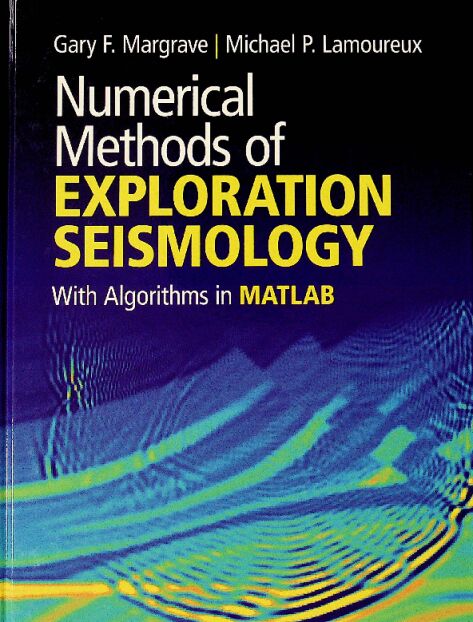
书名:Numerical methods of exploration seismology
责任者:Gary F. Margrave | University of Calgary | Michael P. Lamoureux | University of Calgary.
ISBN\ISSN:9781107170148,1107170141
出版时间:2019
出版社:Cambridge University Press,
分类号:天文学、地球科学
页数:xi, 444 pages; :
摘要
Exploration seismology uses seismic imaging to form detailed images of the Earth's interior, enabling the location of likely petroleum targets. Due to the size of seismic datasets, sophisticated numerical algorithms are required. This book provides a technical guide to the essential algorithms and computational aspects of data processing, covering the theory and methods of seismic imaging. The first part introduces an extensive online library of MATLAB® seismic data processing codes maintained by the CREWES project at the University of Calgary. Later chapters then focus on digital signal theory and relevant aspects of wave propagation and seismic modelling, followed by deconvolution and seismic migration methods. Presenting a rigorous explanation of how to construct seismic images, it provides readers with practical tools and codes to pursue research projects and analyses. It is ideal for advanced students and researchers in applied geophysics, and for practicing exploration geoscientists in the oil and gas industry.
查看更多
前言
Exploration seismology is a complex technology that blends advanced physics, mathematics, and computation. Seismic imaging, an essential part of exploration seismology, has evolved over roughly 100 years of effort into a sophisticated imaging system capable of forming detailed 3D images of the interior of the Earth’s crust. We have been involved in research, teaching, and practice in this field for many decades and this book is an outgrowth of our experience. With it we hope to bring a more detailed understanding of the methods of seismic imaging to a broad audience of scientists and engineers.
Often, the computational aspect is neglected in teaching because, traditionally, seismic processing software is part of an expensive and complex system. Also, understanding the numerical methods behind the software requires a considerable knowledge of digital signal theory, which is often omitted in a typical graduate curriculum. However, it is our opinion that true understanding only comes through mastering the computational aspects as well as the concepts and mathematics. We have often been surprised at the additional mental struggle required to transition from a formula in a book to an actual digital computation of the same formula. Even so, we have never regretted spending the extra time needed for that purpose.
This book is intended for those scientists who wish for an introduction to the computational aspects as well as the theory of seismic data processing. Such people may be graduate students at universities, professional data processors in seismic processing companies, researchers in energy companies, or literally anyone who wishes to gain a greater understanding of seismic data-processing algorithms. The appropriate background for this material is roughly that achieved at the B.Sc. level in physics, mathematics, or geoscience. Knowledge of vector calculus, undergraduate physics, some understanding of geophysics, and experience with a computer programming language (not necessarily MATLAB) are all assumed as background.
This book and the MATLAB library it describes are the product of many years of teaching and research at the University of Calgary and in industry. The first author began the development of the library while employed at Chevron and, with Chevron’s permission, continued this development after joining the University of Calgary and the Consortium for Research in Elastic-Wave Exploration Seismology (CREWES) in 1995. He is now retired from the university, and still evolving the codes. The second author became involved because the mathematical complexity of the seismic imaging problem appealed to his expertise in functional analysis and signal processing, as a member of the university’s Department of Mathematics and Statistics. Both authors are involved in an ongoing collaboration with one another and with other members of the CREWES project, and these codes are the fruit of that collaboration.
We have chosen to limit the scope of this volume primarily to those methods that can be regarded as “single-channel algorithms.” This term means that these methods act one at a time on each of the millions or even billions of 1D time series that comprise a seismic dataset. Mostly in our final chapter, we do discuss some multichannel methods but these only scratch the surface of what can be found in our MATLAB library. Even to describe the single-channel methods in algorithmic detail requires a lengthy introduction to digital signal theory, our Chapters 2 and 3, and also a solid introduction to the relevant mathematical physics, Chapter 4, which then culminates in a detailed discussion of deconvolution methods in Chapter 5. Chapters 6 and 7 comprise an introduction to seismic migration methods.
We hope this book proves useful to our readers, and welcome any feedback. We realize that it will seem overly complex to some, while others will find it lacking in detail essential to their interests. We only ask for understanding that it is difficult to satisfy all readers, but we hope that all who make the required effort will find value here.
查看更多
目录
Preface page ix
Note on Online Resources xi
How to Obtain the MATLAB Codes xi
1 Introduction to MATLAB and Seismic Data 1
1.1 Scope and Prerequisites 1
1.2 MATLAB Conventions Used in This Book 3
1.3 Seismic Wavelets 6
1.4 Dynamic Range and Seismic Data Display 10
1.5 Programming Tools 28
1.6 Programming for Efficiency 35
1.7 Chapter Summary 40
2 Signal Theory: Continuous 41
2.1 What is a Signal? 41
2.2 Crosscorrelation and Autocorrelation 42
2.3 Convolution 48
2.4 The Fourier Transform 55
2.5 Multidimensional Fourier Transforms 90
2.6 Chapter Summary 103
3 Signal Theory: Discrete 104
3.1 Sampling 104
3.2 Interpolation, Aliasing, and Resampling 116
3.3 Discrete Convolution 121
3.4 The Discrete Fourier Transform 136
3.5 Discrete Minimum Phase 149
3.6 Filtering and Spectral Analysis 155
3.7 Time–Frequency Analysis 165
3.8 Multidimensional Discrete Fourier Transforms 171
3.9 Chapter Summary 181
4 Wave Propagation and Seismic Modeling 182
4.1 Introduction 182
4.2 The Wave Equation Derived from Physics 184
4.3 Waveform Changes in Heterogeneous Wave Equation 194
4.4 Waves in an Elastic Medium 195
4.5 Finite-Difference Modeling with the Acoustic Wave Equation 196
4.6 The One-Dimensional Synthetic Seismogram 206
4.7 MATLAB Tools for 1D Synthetic Seismograms 215
4.8 Chapter Summary 244
5 Deconvolution: The Estimation of Reflectivity 245
5.1 The Deconvolution Trace Model 245
5.2 Gain Correction 249
5.3 Frequency-Domain Stationary Spiking Deconvolution 254
5.4 Time-Domain Stationary Spiking Deconvolution 266
5.5 Predictive Deconvolution 276
5.6 Nonstationary Deconvolution 288
5.7 Chapter Summary 306
6 Velocity Measures and Ray Tracing 309
6.1 Instantaneous Velocity: vins or Just v 310
6.2 Vertical Traveltime: τ 311
6.3 vins as a Function of Vertical Traveltime: vins(τ) 312
6.4 Average Velocity: vave 313
6.5 Mean Velocity: vmean 314
6.6 RMS Velocity: vrms 315
6.7 Interval Velocity: vins 317
6.8 MATLAB Velocity Tools 320
6.9 Apparent Velocity: vx, vy, vz 323
6.10 Snell’s Law 326
6.11 Ray Tracing in a v(z) Medium 327
6.12 Ray Tracing for Inhomogeneous Media 343
6.13 Chapter Summary 350
7 Elementary Migration Methods 351
7.1 Stacked Data 352
7.2 Fundamental Migration Concepts 361
7.3 MATLAB Facilities for Simple Modeling and Raytrace Migration 377
7.4 Fourier Methods 389
7.5 Kirchhoff Methods 408
7.6 Finite-Difference Methods 417
7.7 Practical Considerations for Finite Datasets 423
7.8 Chapter Summary 434
References 435
Index 438
查看PDF
查看更多
作者简介
Michael P. Lamoureux is a Professor of Mathematics at the University of Calgary, with a research focus on functional analysis and its application to physics, signal processing, and imaging. He has a keen interest in developing advanced mathematical methods for use in real industrial settings.
查看更多
馆藏单位
中科院文献情报中心