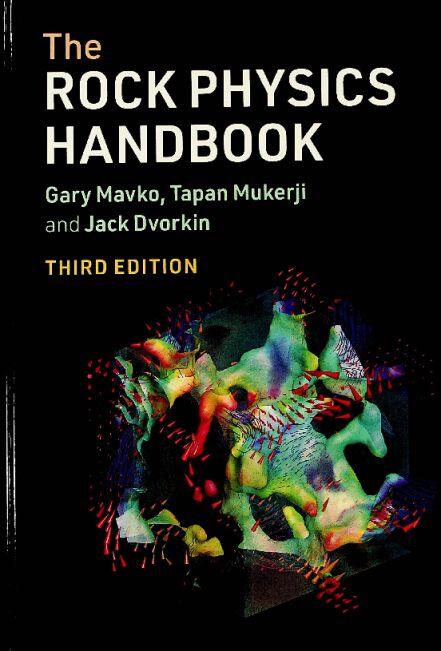
书名:The rock physics handbook
责任者:Gary Mavko | Stanford University | California | Tapan Mukerji | Stanford University | California | Jack Dvorkin | King Fahd University of Petroleum and Minerals | Saudi Arabia.
出版时间:2020
出版社:Cambridge University Press
分类号:天文学、地球科学
版次:Third edition.
页数:xii, 727 pages :
前言
In the decade since publication of the Second Edition of the Rock Physics Handbook, research and application of rock physics have continued to thrive and mature. Today, areas of study where rock physics plays a role include oil and gas exploration and production, geothermal resources, ground water management, near-surface geophysics, earthquake seismology, geodynamics, geotechnical engineering, rock mechanics, glaciology, and even lunar and planetary sciences.
While preparing the Third Edition, our objective was still to summarize in a convenient form many of the commonly needed theoretical and empirical relations of rock physics. Our approach was to present results, with a few of the key assumptions and limitations, and almost never any derivations. Our intention was to create a quick reference and not a textbook. Hence, we chose to encapsulate a broad range of topics rather than to give in-depth coverage of a few. Even so, there are many topics that we have not addressed. While we have summarized the assumptions and limitations of each result we hope that the brevity of our discussions does not give the impression that application of any rock physics result to real rocks is free of pitfalls. We assume that the reader will generally be aware of the various topics, and, if not, we provide a few references to the more complete descriptions in books and journals.
The Third Edition contains 121 sections on basic mathematical tools, elasticity theory, wave propagation, effective media, elasticity and poroelasticity, granular media, and pore-fluid flow and diffusion, plus overviews of dispersion mechanisms, fluid substitution, and Vp-Vs rela-tions. The book also presents empirical results derived from reservoir rocks, sediments, and granular media, as well as tables of data on minerals, magmas and melts, gases, ice, hydrates, and an atlas of reservoir rock properties. The emphasis is still on elastic and seismic topics, though the discussion of electrical and cross seismic-electrical relations has grown. An associated website (http://srb.stanford.edu/books) offers MATLAB codes for many of the models and results described in the Third Edition.
In this Third Edition, Chapter 1 has been expanded to include the Laplace Transform and basic tensor operations. Chapter 2 includes new discussions on two-dimensional elasticity, anisotropic Poison's ratio and Young's modulus, Eshelby's theory, and stress intensity factors. Chapter 3 has a more extensive discussion of viscoelasticity, relevant to both wave dispersion and attenuation, and time-domain creep. Chapter 4 has gained a more comprehensive discus-sion of elastic bounds, an expanded discussion of effective medium inclusion models, and estimates and bounds on the effective moduli of polycrystalline rock aggregates. Chapter 5, on granular media, has an expanded dicussion of sand-clay mixing models, ideal and non-idea particle mixture properties, and percolation in particle packs. Chapter 6 has an expanded discussion of petroleum oil, gas, and condensates, and new elastic discussions on fluid and solid substitution, rigorous bounds on fluid substitution, and elastic mineral substitution. Chapter 7 has gained new elastic models of clastic sediments, including shales. Chapter 8 has a new discussion on extensions to the Kozeny-Carman relations, diffusion of pressure, flow properties of viscous fluids containing particles and bubbles, and viscosity of silicate melts and magmas. The Appendix has been expanded to include new plots of representative rock proper-ties, and extensive new tables of properties of crustal and mantle rocks and minerals, melts and magmas, fresh-water and sea-water ices, polycrystalline salt, and commonly used dimension-less numbers.
This Handbook is complementary to a number of other excellent books. For in-depth discussionsof specific rock physics topics, we recommend Fundamentals of Rock Mechanics, 4th edition, by Jaeger, Cook, and Zimmerman; Compressibility of Sandstones by Zimmerman; Physical Properties of Rocks: Fundamentals and Principles of Petrophysics by Schön; Acoustics of Porous Media by Bourbié, Coussy, and Zinszner; Introduction to the Physics of Rocks by Guéguen and Palciauskas; A Geoscientists Guide to Petrophysics by Zinszner and Pellerin; Theory of Linear poroelasticity by Wang; Underground Sound by White; Mechanics of Composite Materials by Christensen; Viscoelastic Materials by Lakes; The Theory of Composites by Milton; Random Heterogeneous Materials by Torquato; Rock Physics and Phase Relations edited by Ahrens; Offset Dependent Reflectivity: Theory and Practice of AVO Analysis edited by Castagna and Backus; Seismic Petrophysics in Quantitative Interpretation by Vernik; Seismic Amplitude: An Interpreter’s Handbook by Simm and Bacon; and Seismic Reflections of Rock Properties by Dvorkin, Gutierrez, and Grana.
We wish to thank the students, scientific staff, and industrial affliates of the Stanford Rock Physics and Borehole Geophysics (SRB) project for many valuable comments and insights. Mustafa Al Ibrahim contributed heavily to the section on kerogen properties; Li Teng con-tributed to the chapter on anisotropic AVOZ; and Ran Bachrach contributed to the chapter on dielectric properties. We benefited extensively from discussions with Amos Nur, Nishank Saxena, Vishal Das, Sabrina Aliyeva, Yu Xia, Priyanka Dutta, Nattavadee Srisutthiyakom, Abdulla Kerimov, Uri Wollner, Iris(Yunfei) Yang, Wei Chu, Rayan Kanfar, Obai Shaikh, Salma Alsinan, Abrar AlAbbad, Salman Alkhater, Chen Guo, and Juan Pablo Daza. Juan Pablo also created and graciously shared the digital rock image shown on the cover. We thank the readers who pointed out errors in the previous editions.
We hope you find this updated edition useful.
Gary Mavko, Tapan Mukerji, and Jack Dvorkinwho pointed out errors in the previous editions.
We hope you find this updated edition useful.
Gary Mavko, Tapan Mukerji, and Jack Dvorkin
查看更多
目录
Preface to the Third Edition page xi
1 Basic Tools 1
1.1 The Fourier Transform 1
1.2 The Hilbert Transform and Analytic Signal 7
1.3 The Laplace Transform 10
1.4 Statistics and Probability 12
1.5 Coordinate Transformations 21
1.6 Tensor Properties and Operations 25
2 Elasticity and Hooke's Law 37
2.1 Elastic Moduli: Isotropic Form of Hooke's Law 37
2.2 Anisotropic Form of Hooke's Law 44
2.3 Thomsen's Notation for Weak Elastic Anisotropy 57
2.4 Sayers' Simplified Notation for Weak VTI Anisotropy 61
2.5 Tsvankin's Extended Thomsen Parameters for Orthorhombic Media 62
2.6 Third-Order Nonlinear Elasticity 64
2.7 Effective Stress Properties of Rocks 66
2.8 Stress-Induced Anisotropy in Rocks 70
2.9 Strain Components and Equations of Motion in Cylindrical and Spherical Coordinate Systems 80
2.10 Deformation of Inclusions and Cavities in Elastic Solids 81
2.11 Deformation of a Circular Hole: Borehole Stresses 96
2.12 Eshelby's General Solution for Ellipsoidal Inclusions 102
2.13 Mohr's Circles 109
2.14 Static and Dynamic Moduli 112
2.15 Stress Intensity Factors 115
3 Seismic Wave Propagation 121
3.1 Seismic Velocities 121
3.2 Phase, Group, and Energy Velocities 123
3.3 NMO in Isotropic and Anisotropic Media 126
3.4 Impedance, Reflectivity, and Transmissivity 133
3.5 Reflectivity and Amplitude Variations with Offset (AVO) in Isotropic Media 136
3.6 Plane-Wave Reflectivity in Anisotropic Media 144
3.7 Elastic Impedance 154
3.8 Viscoelasticity and Q 160
3.9 Kramers-Kronig Relations between Velocity Dispersion and Q 179
3.10 Waves in Layered Media: Full-Waveform Synthetic Seismograms 181
3.11 Waves in Layered Media: Stratigraphic Filtering and Velocity Dispersion 185
3.12 Waves in Layered Media: Frequency-Dependent Anisotropy, Dispersion, and Attenuation 189
3.13 Scale-Dependent Seismic Velocities in Heterogeneous Media 197
3.14 Scattering Attenuation 201
3.15 Waves in Cylindrical Rods: the Resonant Bar 206
3.16 Waves in Boreholes 211
4 Effective Elastic Media: Bounds and Mixing Laws 220
4.1 Voigt and Reuss Bounds 220
4.2 Hashin-Shtrik man-Walpole Bounds 222
4.3 Improvements on the Hash in-S trikman-Walpole Bounds 229
4.4 Wood's Formula 234
4.5 Voigt-Reuss-Hll Average Moduli Estimate 235
4.6 Composite with Uniform Shear Modulus 236
4.7 Rock and Pore Compressibilities and Some Pitfalls 238
4.8 General Comments on Inclusion-Based Esimation Models 241
4.9 Mori-Tanaka Formulation for Effective Moduli 248
4.10 Kuser and Toksöz Formulation for Effective Moduli 249
4.11 Self-Consistent Approximations of Effective Moduli 251
4.12 Differental Effective Medium Model 255
4.13 Hudson's Model for Cracked Media 258
4.14 Eshelby-Cheng Model for Cracked Anisotropic Media 267
4.15 T-Matrix Inclusion Models for Effective Moduli 269
4.16 Elastic Constants in Finely Layered Media: Backus Average 275
4.17 Elastic Constants in Finely Layered Media: General Layer Anisotropy 279
4.18 Poroelastic and Viscoelastic Backus Average 280
4.19 Seismic Response to Fractures 285
4.20 Bound-Filling Models 290
4.21 Effective Moduli of Polycrystalline Aggregates 295
4.22 Comments on the Representative Volume Element 304
4.23 A Few Theorems on Strain in an Effective Medium 306
5 Granular Media 309
5.1 Packing and Sorting of Spheres and Irregular Particles 309
5.2 Percolation of Random Ellipsoidal Packs 325
5.3 Thomas-Stieber-Yin-Marion Model for Sand-Shale Systems 329
5.4 Particle Size and Sorting 335
5.5 Random Spherical Grain Packings: Contact Models and Effective Moduli 337
5.6 Ordered Spherical Grain Packings: Effective Moduli 364
6 Fluid Effects on Wave Propagation 367
6.1 Biot's Velocity Relations 367
6.2 Geertsma-Smit Approximations of Biot's Relations 372
6.3 Gassmann's Relations: Isotropic Form 374
6.4 Bounds on Fluid Substitution 384
6.5 Brown and Korringa's Generalized Gassmann Equations for Mixed Mineralogy 385
6.6 Fluid Substitution in Anisotropic Rocks 387
6.7 Generalized Gassmann's Equations for Composite Porous Media 390
6.8 Solid Substitution of Frame or Pore-Filling Phases 393
6.9 Fluid Substitution in Thinly Laminated Reservoirs 407
6.10 BAM: Marion's Bounding Average Method 412
6.11 Mavko-Jizba Squirt Relations 413
6.12 Extension of Mavko-Jizba Squirt Relations for All Frequencies 416
6.13 Biot-Squirt Model 419
6.14 Chapman et al. Squirt Model 421
6.15 Anisotropic Squirt 423
6.16 Common Features of Fluid-Related Velocity Dispersion Mechanisms 427
6.17 Dvorkin-Mavko Attenuation Model 433
6.18 Partial and Multiphase Saturations 438
6.19 Partial Saturation: White and Dutta-Odé Model for Velocity Dispersion and Attenuation 444
6.20 Velocity Dispersion, Attenuation, and Dynamic Permeability in Heterogeneous Poroelastic Media 449
6.21 Waves in a Pure Viscous Fluid 455
6.22 Physical Properties of Gases and Fluids 457
7 Empirical Relations 474
7.1 Velocity-Porosity Models: Critical Porosity and Modified Upper and Lower Bounds 474
7.2 Velocity-Porosity Models: Wyllie's Time Averageand Geertsma's Empirical Relations for Compressibility 478
7.3 Vernik-Kachanov Clastics Models 480
7.4 Velocity-Porosity Models: Raymer-Hunt-Gardner Relations 482
7.5 Velocity-Porosity-Clay Models: Han's Empirical Relations for Shaly Sandstones 485
7.6 Velocity-Porosity-Clay Models: Tosaya's Empirical Relations for Shaly Sandstones 486
7.7 Velocity-Porosity-Clay Models: Castagna's Empirical Relationsfor Velocities 487
7.8 Vp-Vs-Density Models: Brocher's Compilation 488
7.9 Vp-Vs Relations 492
7.10 Velocity-Density Relations 508
7.11 Eaton and Bowers Pore-Pressure Relations 511
7.12 Kan and Swan Pore-Pressure Relations 512
7.13 Attenuation and Quality Factor Relations 513
7.14 Velocity-Porosity-Strength Relations 515
7.15 Birch's Law 517
7.16 Kerogen Properties 519
8 Flow and Diffusion 525
8.1 Darcy's Law 525
8.2 Viscous Flow 533
8.3 Capillary Forces 538
8.4 Kozen y-Carman Relation for Flow 542
8.5 Permeability Relations with Swi 557
8.6 Permeability of Fractured Formations 560
8.7 Diffusion and Filtration: Special Cases 562
8.8 Heavy Oil Viscosity and Shear Modulus 564
8.9 Particles and Bubbles in a Viscoelastic Background 567
8.10 Viscosity of Silicate Melts and Magma 571
9 Electrical Properties 577
9.1 Bounds and Effective Medium Models 577
9.2 Velocity Dispersion and Attenuation 582
9.3 Empirical Relations for Composites 585
9.4 Electrical Conductivity in Porous Rocks 588
9.5 Cross-Property Bounds and Relations between Elastic and Electrical Parameters 596
9.6 Brine Resistivity 608
9.7 Dielectric Constants 611
Appendices 613
A.1 Typical Rock Properties 613
A.2 Conversions 634
A.3 Physical Constants 638
A.4 Moduli and Density of Common Minerals 641
A.5 Properties of Mantle Minerals 650
A.6 Properties of Melts, Magma, and Igneous Rocks 653
A.7 Velocities and Moduli of Ice, Methane Hydrate, and Sea Water 659
A.8 Physical Properties of Common Gases 663
A.9 Velocity, Moduli, and Density of Carbon Dioxide 669
A.10 Standard Temperature and Pressure 672
References 673
Index 716
查看PDF
查看更多
馆藏单位
中科院文献情报中心