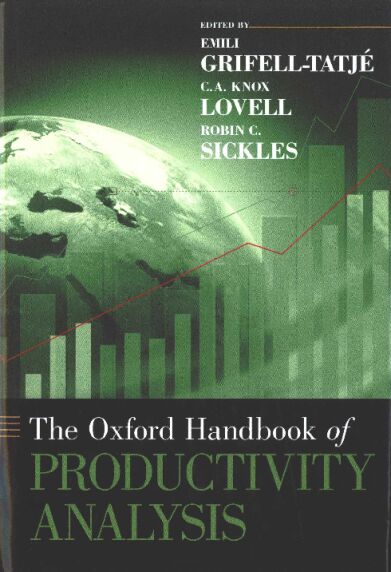
书名:The Oxford handbook of productivity analysis
责任者:Emili Grifell-Tatje | C. A. Knox Lovell | and Robin C. Sickles. | Lovell, C. A. Knox. | Sickles, Robin.
出版时间:2018
出版社:Oxford University Press
摘要
Our objective in this chapter is to provide an overview of some important aspects of productivity analysis, many of which are addressed in subsequent chapters in this Handbook.
In section 1.2 we stress the economic significance of productivity growth. In subsections 1.2.1 and 1.2.2 we focus on the impact of productivity growth on business financial performance and on the growth of the aggregate economy, the two being linked by the fact that successful businesses grow, and their expansion drives growth in the aggregate economy. At each level, productivity growth has been a historically important driver of performance, although its degree of importance has varied with trends in other potential drivers and with external circumstances. In subsection 1.2.3 we assume that aggregate productivity growth occurs and ask whether this is sufficient for an improvement in economic welfare, a much broader concept than that of economic output such as gross domestic product (GDP). This leads us into the literature directed at the increasingly popular but stubbornly elusive concepts of social progress and inclusive growth.
In section 1,3 we explore definition, quantification, and implementation, the procedures through which productivity measures are obtained. In subsection 1.3.1 we define alternative measures of productivity and its rate of change, suggesting some properties that these measures might be asked to satisfy. In subsection 1.3.2 we review two approaches to quantifying productivity change: one, which we call calculation, based exclusively on quantity and price data, and the other, which we call estimation, based on quantity and price data augmented by economic theory. In subsection 1.3.3 we consider some implementation issues confronting statistical agencies responsible for constructing and disseminating productivity and related measures of economic activity.
In section 1.4 we introduce productivity dispersion among producers. Dispersion matters because aggregate productivity is inversely correlated with the extent of disaggregate dispersion. In subsection 1.4.1 we review the evidence, which shows productivity dispersion to be widespread. In subsection 1.4.2 we introduce productivity dynamics, which considers two possible consequences of productivity dispersion. In one scenario, market forces generate a reallocation of resources away from productivity laggards toward productivity leaders that narrows dispersion and raises aggregate productivity. In the other scenario, barriers to the working of market forces or other factors allow dispersion to persist.
In section 1.5 we consider some forces, both internal and external to business, which contribute to productivity and its dispersion. In subsection 1.5.1 we consider technology-based drivers, for which we need information on the underlying production technology. We define productivity change in terms of the technology, and we decompose productivity change into its technology-based drivers, historically the most significant of which has been technical progress, which is inferred from outward shifts in production technology. In subsection 1.5.2 we analyze organizational and institutional drivers, the former being internal to the business and the latter being external to the business. The organizational drivers revolve around management and its practices, including human resource practices, and technology adoption strategies. The institutional drivers include various features of the business’s operating environment that can enhance, as well as impede, productivity. Many of these drivers, such as the regulatory environment, are amenable to public policy intervention.
The lengthy list of references that follows is meant to serve as a readers’ guide to the topics we discuss, and to encourage interdisciplinary reading.
查看更多
目录
Contributors ix
PART I EDITORS’ INTRODUCTION
1. Overview of Productivity Analysis: History, Issues, and Perspectives [Emili Grifell-Tatje, C. A. Knox Lovell, and Robin C. Sickles] 3
PART II THE FOUNDATIONS OF PRODUCTIVITY ANALYSIS
2. Empirical Productivity Indices and Indicators [Bert M. Balk] 77
3. The US Bureau of Labor Statistics Productivity Program [Lucy P. Eldridge, Chris Sparks, and Jay Stewart] 121
4. Theoretical Productivity Indices [R. Robert Russell] 153
5. Dynamic Efficiency and Productivity [Rolf Fare, Shawna Grosskopf, Dimitris Margaritis, and William L. Weber] 183
6. Productivity Measurement in Sectors with Hard-to-Measure Output [Kim Zieschang] 211
7. Productivity Measurement in the Public Sector [W. Erwin Diewert] 241
8. Productivity Measurement and the Environment [Finn R. Forsund] 287
PART III MICROECONOMIC STUDIES
9. Productivity and Financial Performance [Emili Grifell-Tatje and C. A. Knox Lovell] 329
10. Business Model Innovation and Replication: Implications for the Measurement of Productivity [Roberto Garcia-Castro, Joan Enric Ricart, Marvin B. Lieberman, and Natarajan Balasubramanian] 359
11. The Labor Productivity of Family Firms: A Socioemotional Wealth Perspective [Shainaz Firfiray, Martin Larraza-Kintana, and Luis R. Gomez-Mejia] 387
12. Innovation, Management Practices, and Productivity [Mary J. Benner] 411
13. Internationalization, Innovation, and Productivity [Bruno Cassiman and Elena Golovko] 437
14. Effect of International Competition on Firm Productivity and Market Power [Jan De Loecker and Johannes Van Biesebroeck] 463
15. Efficiency Measures in Regulated Industries: History, Outstanding Challenges, and Emerging Solutions [Laurens Cherchye, Bram De Rock, Antonio Estache, AND MARIJN VERSCHELDE] 493
16. Theory, Techniques, and Applications of Regulatory Benchmarking and Productivity Analysis [Per J. Agrell and Peter Bogetoft] 523
PART IV MACROECONOMIC STUDIES
17. Productivity and Welfare Performance in the Public Sector [Mathieu Lefebvre, Sergio Perelman, and Pierre Pestieau] 557
18. Measuring Productivity Dispersion [Eric J. Bartelsman and Zoltan Wolf] 593
19. Decomposing Value- Added Growth into Explanatory Factors [W. Erwin Diewert and Kevin J. Fox] 625
20. The World KLEMS Initiative: Measuring Productivity at the Industry Level [Dale W. Jorgenson] 663
21. Productivity and Substitution Patterns in Global Value Chains [Marcel P. Timmer and Xianjia Ye] 699
22. The Industry Sources of Productivity Growth and Convergence [Robert Inklaar] 725
23. Productivity and Economic Development [Hak K. Pyo] 753
24. The Productivity of Nations [Oleg Badunenko, Daniel J. Henderson, and Valentin Zelenyuk] 781
Author Index 817
Subject Index 837
查看更多
馆藏单位
中国农科院农业信息研究所