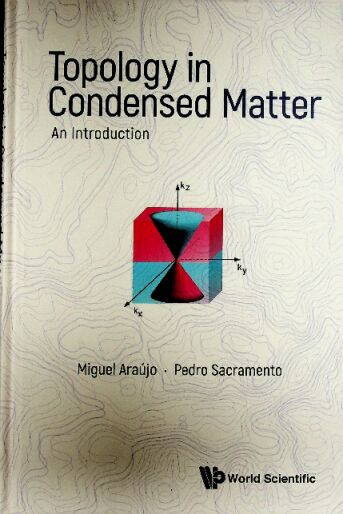
书名:Topology in condensed matter
责任者:Miguel Araújo | Pedro Sacramento.
出版时间:2021
出版社:World Scientific,
摘要
This text serves as a pedagogical introduction to the theoretical concepts on application of topology in condensed matter systems. It covers an introduction to basic concepts of topology, emphasizes the relation of geometric concepts such as the Berry phase to topology, having in mind applications in condensed matter. In addition to describing two basic systems such as topological insulators and topological superconductors, it also reviews topological spin systems and photonic systems. It also describes the use of quantum information concepts in the context of topological phases and phase transitions, and the effect of non-equilibrium perturbations on topological systems. PF\This book provides a comprehensive introduction to topological insulators, topological superconductors and topological semimetals. It includes all the mathematical background required for the subject. There are very few books with such a coverage in the market.
查看更多
目录
Preface to the Portugese Edition v
1. Basic notions on topology 1
1.1 Loop at x 1
1.2 Homotopy classes based at x 2
1.3 The fundamental group π1 2
1.4 The second homotopy group π2 4
1.5 Examples of domains and groups 6
1.6 Application to the Hamiltonians of fermionic systems 6
2. Concepts 11
2.1 Berry phase 11
2.2 Berry phase effects 13
2.2.1 Electric polarization of the unit cell 13
2.2.2 Adiabatic current 14
2.2.3 Anomalous velocity 16
2.3 Discrete symmetries 17
2.4 Topology of one-dimensional systems 23
2.4.1 Shockley model and winding number 23
2.4.2 Zak phase 25
2.4.3 The number of edge states 26
2.4.4 Higher dimensional Hamiltonian 26
2.5 The two-level system 27
2.6 Two-dimensional systems: the Chern number 29
2.7 Calculating the Chern number from plaquettes 32
2.8 Berry curvature as a stun over states 33
2.9 Edge states 34
2.10 Quantum transport by edge states 36
2.10.1 Quantum transport in one dimension 36
2.10.2 Hall conductance in two-dimensional systems 37
2.10.3 Quantum Hall effect 39
2.11 Dimensional reduction 40
2.12 Edge states in graphene 40
2.13 The calculation of edge states 43
3 Topological insulators 47
3.1 The construction of the anomalous Hall insulator 47
3.2 Graphene and Haldane model 49
3.3 Edge states in Haldane model 50
3.4 The Chem insulator in a magnetic field 51
3.5 Kane-Mele topological insulator 53
3.6 The topological Z2 index 54
3.7 The three-dimensional topological insulator 57
3.8 Models for topological insulators 58
3.9 Higher order topological insulators 61
3.10 Symmetry classes of gapped Hamiltonians 61
4. Topological superconductors 65
4.1 Bogoliubov-de Gennes equations 65
4.1.1 Particle-hole symmetry 66
4.1.2 Superconducting pairing 68
4.1.3 The BCS wave function 71
4.1.4 Majorana fermions 71
4.1.5 The Nambu (or Balian-Werthammer) basis 72
4.2 One-dimensional Kitaev model 74
4.2.1 Representation of the Kitaev model by Majorana fermions 75
4.2.2 Fernaionic parity of the groundstate 78
4.2.3 Extended Kitaev model 80
4.2.4 Shockley model expressed by Majorana fermions 82
4.2.5 SSH model with triplet pairing 83
4.3 Bound states in Josephson junctions 89
4.3.1 Majorana states in a π junction 89
4.3.2 Andreev bound states in a ø junction 91
4.4 Two-dimensional superconductors 93
4.4.1 The spinless p+ip superconductor 93
4.4.2 Dirac cone with s-wave superconductivity 96
4.4.3 The Z2 superconductor 98
4.4.4 Inclusion of pseudo-spin 98
4.4.5 Examples of superconductors in a two-dimensional lattice 100
4.4.6 Sato and Fujimoto model of a triplet superconductor 103
4.5 Superconductor with impurities 107
4.5.1 Magnetic chain on a singlet superconductor 110
4.5.2 Magnetic chain on a triplet superconductor 112
4.5.3 Chern number in real space 114
5. Topological semimetals 121
5.1 Definition and symmetries 121
5.2 Type I Weyl points 122
5.2.1 Sources and drains of Berry curvature 123
5.2.2 Density of states 124
5.3 Surface states with "Fermi arcs" 124
5.4 Chiral anomaly 126
5.5 Perturbation of a Dirac point 128
5.6 Type II Weyl points 129
5.7 Nodal rings 130
5.7.1 Topological invariant for nodal lines 131
5.7.2 Drumhead edge states 133
5.8 Z2 nodal rings 134
6. Spin systems with topological properties 139
6.1 Representations of spill systems 139
6.2 Spin chains 142
6.2.1 AKLT projection 143
6.2.2 Berry phase 146
6.3 Topological defects 149
6.3.1 Hedgehogs and skyrmions 150
6.3.2 Vortices and Kosterlitz-Thouless transition 151
6.4 Duality and topology 156
6.4.1 Inverse Jordan-Wigner transformation 156
6.4.2 Fermionic representations of the one-dimensional Kitaev model 157
6.4.3 Berry phase and change of representation 159
6.4.4 Topology of the spin model in the fermionic representation 162
7. Photonic systems with topological properties 167
7.1 Topological phases in photonic systems 167
7.2 Edge modes with time reversal symmetry breaking 168
7.2.1 Waveguides 168
7.2.2 Ferrite tubes 171
7.2.3 Waves in a periodic system: photonic crystals 174
7.2.4 TM modes in a periodic lattice 176
7.2.5 Effective model for quadratic bands 177
7.2.6 Experimental implementation 180
7.3 Systems with time reversal symmetry 182
7.3.1 Scattering of a particle by a potential 182
7.3.2 S matrix for the scattering of electromagnetic waves 184
8. Quantum information and topological systems 189
8.1 Entanglement 189
8.1.1 von Neumann entropy 191
8.1.2 Relation with correlation functions 192
8.1.3 Impurity in a conventional superconductor 194
8.2 Entanglement spectrum 196
8.2.1 Entanglement in real space 196
8.2.2 Momentum space entanglement 198
8.3 Fidelity 200
8.3.1 Pure states 200
8.3.2 Fidelity between partial states 201
8.3.3 Two-level system 202
8.3.4 States of a superconductor with magnetic impurities 203
8.3.5 Fidelity spectrum and phase transitions in quantum systems 205
8.3.6 Fidelity spectrum of a topological superconductor 206
8.3.7 Quantum phase transition in Kitaev model 209
8.3.8 Fidelity susceptibility 209
8.4 Non-abelian permutation of Majorana fermions 211
8.4.1 Products of Majorana fermions 212
8.4.2 Flux quantization and Majoranas permutations 213
9. Out of equilibrium topological systems 221
9.1 Sudden quantum transformations 221
9.1.1 Survival probability and Losclunidt echo 221
9.1.2 Energy non-conservation 224
9.1.3 Kitaev model: stability of edge states 227
9.1.4 Sato and Fujimoto model: stability of edge modes 228
9.1.5 Evolution of the Chem numbers 229
9.2 Periodic perturbations: Floquet systems 232
9.2.1 Dirac cone under circularly polarized radiation 235
9.2.2 Magnus expansion 236
9.2.3 Invariants: frequency space formulation 237
9.2.4 Quasi-energy bands and creation of π modes 240
9.2.5 Invariants: time formulation 242
9.2.6 Berry-Floquet phase 243
9.3 Instantaneous periodic pulses 244
9.3.1 Eigenvalues of the Floquet operator 245
9.3.2 Effective Hamiltonian 245
Appendix A Physical realization of Kitaev model 251
Appendix B Fermi surface topology 255
Index 261
查看更多
馆藏单位
中科院文献情报中心