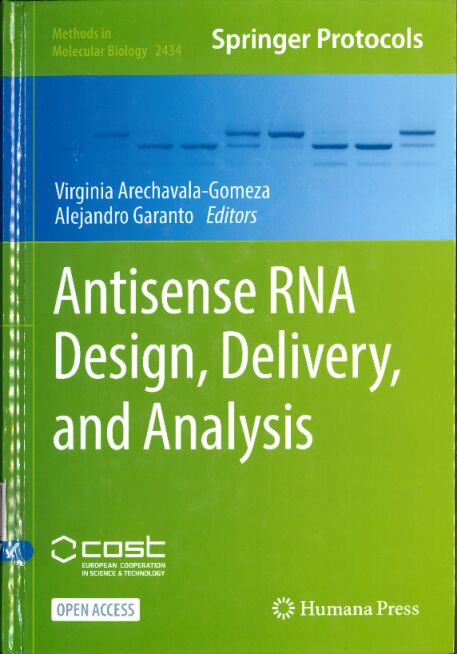
书名:Antisense RNA design, delivery, and analysis
责任者:Virginia Arechavala-Gomeza | Alejandro Garanto.
出版时间:2022
出版社:Humana Press,
分类号:生物科学
页数:xvii, 422 p. :
前言
The field of RNA therapeutics has rapidly changed over the last few years. Particularly, two mRNA vaccines for SARS-CoV-2 and a customized oligonucleotide for an n-of-l trial have revolutionized the expectations in the field. Although the use of RNA-based molecules as treatments has been investigated for several decades, this recent surge of applications has seen more and more researchers embarking on the design and assessment of such therapies. The main objective of this book is to provide basic knowledge and a large collection of methods to facilitate the work of these newcomers to the field who want to exploit antisense technology as a therapeutic intervention.
This book was conceived thanks to the network DARTER (Delivery of Antisense RNA Therapeutics, https://www.antisenserna.eu). DARTER is funded by the EU Cooperation of Science and Technology (COST), which aims to enhance interaction and collaborations between researchers in Europe and other countries (https://www.cost.eu/). Within DARTER, we aim to exchange knowledge and protocols and explore the full potential of antisense technology in an environment that combines academia, industry, and patient representatives. This book depicts the variety of models, delivery systems, and approaches that can be used to assess RNA technology and has combined the expertise of researchers located in ten different countries.
Among the 28 chapters included in this book, we have commissioned several review chapters that cover aspects from the historical development of nucleic acid therapeutics, the clinical applications of antisense oligonucleotides, and considerations to include in the preclinical evaluation of the oligonucleotide-mediated toxicology, to patent issues that may need to be contemplated. The remaining chapters follow a classical protocol structure, and we have divided them attending to the subject covered: the design of antisense technology and their delivery (Part II), the description of the model systems developed to evaluate their efficacy, both in vitro (Part III) and in vivo (Part IV), methods to evaluate preclinically the toxicity associated with these new potential drugs (Part V), and intellectual property considerations (Part VI).
We thank all contributing authors for their tremendous effort including their secret tips in the notes of their protocols. We also thank COST for facilitating the cooperation between the research groups and for making it possible for this book to be published Open Access. We have learned a lot during the revision of this book, and we hope that readers will, too.
查看更多
目录
Preface v
Acknowledgments vii
Contributors xiii
Part I Overview
1 Introduction and History of the Chemistry of Nucleic Acids Therapeutics 3
2 Antisense RNA Therapeutics: A Brief Overview 33
Part II Design and Formulation of Antisense Technology
3 Design of Bifunctional Antisense Oligonucleotides for Exon Inclusion 53
4 Design and Delivery of SINEUP: A New Modular Tool to Increase Protein Translation 63
5 How to Design U1 snRNA Molecules for Splicing Rescue 89
6 Conjugation of Nucleic Acids and Drugs to Gold Nanoparticles 103
7 Determination of Optimum Ratio of Cationic Polymers and Small Interfering RNA with Agarose Gel Retardation Assay 117
8 Generation of Protein-Phosphorodiamidate Morpholino Oligomer Conjugates for Efficient Cellular Delivery via Anthrax Protective Antigen 129
Part III In Vitro Model Systems
9 Development and Use of Cellular Systems to Assess and Correct Splicing Defects 145
10 Modeling Splicing Variants Amenable to Antisense Therapy by Use of CRISPR-Cas9-Based Gene Editing in HepG2 Cells 167
11 In Vitro Models for the Evaluation of Antisense Oligonucleotides in Skin 185
12 In Vitro Delivery of PMOs in Myoblasts by Electroporation 191
13 Rapid Determination of MBNL1 Protein Levels by Quantitative Dot Blot for the Evaluation of Antisense Oligonucleotides in Myotonic Dystrophy Myoblasts 207
14 Evaluation of Exon Skipping and Dystrophin Restoration in In Vitro Models of Duchenne Muscular Dystrophy 217
15 Generation of Human iPSC-Derived Myotubes to Investigate RNA-Based Therapies In Vitro 235
16 Eye on a Dish Models to Evaluate Splicing Modulation 245
17 Establishment of In Vitro Brain Models for AON Delivery 257
Part IV In Vivo Model Systems
18 Considerations for Generating Humanized Mouse Models to Test Efficacy of Antisense Oligonucleotides 267
19 Generation of Humanized Zebrafish Models for the In Vivo Assessment of Antisense Oligonucleotide-Based Splice Modulation Therapies 281
20 Use of Small Animal Models for Duchenne and Parameters to Assess Efficiency upon Antisense Treatment 301
21 In Vivo Models for the Evaluation of Antisense Oligonucleotides in Skin 315
22 Delivery of Antisense Oligonucleotides to the Mouse Retina 321
23 Delivery of Antisense Oligonucleotides to the Mouse Brain by Intracerebroventricular Injections 333
Part V Safety and Toxicology
24 Intrathecal Delivery of Therapeutic Oligonucleotides for Potent Modulation of Gene Expression in the Central Nervous System 345
25 Preclinical Safety Assessment of Therapeutic Oligonucleotides 355
26 Preclinical Evaluation of the Renal Toxicity of Oligonucleotide Therapeutics in Mice 371
27 Protocol for Isolation and Culture of Mouse Hepatocytes (HCs), Kupffer Cells (KCs), and Liver Sinusoidal Endothelial Cells (LSECs) in Analyses of Hepatic Drug Distribution 385
Part VI Intellectual Property
28 Patent Considerations When Embarking on New Antisense Drug Programs 405
Index 419
查看PDF
查看更多
馆藏单位
中国医科院医学信息研究所 中国农科院农业信息研究所