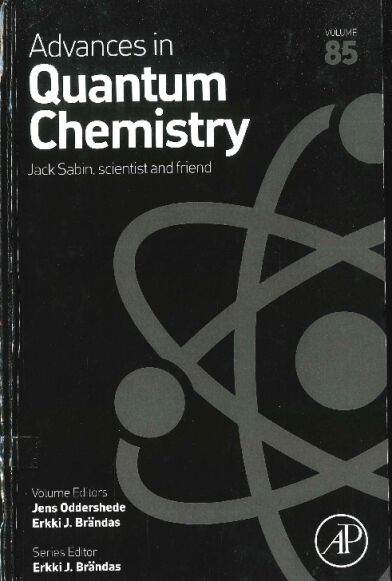
书名:Advances in Quantum Chemistry
责任者:Edited Jens Oddershede | Erkki J. Brandas
出版时间:2022
出版社:Academic Press is an imprint of Elsevier
前言
Professor John R. Sabin from the Quantum Theory Project at the University of Florida has decided to step down as the series editor of Advances in Quantum Chemistry after many years of service to this book series and the quantum chemistry community. Jack Sabin to his friends-and he has very many-has been part of the series for longer than most of us can remember. He became part of the crew involved with the series soon after he joined the faculty at the University of Florida in 1971. In the early days of the Sanibel Symposia, Jack was handling the manuscripts from symposium participants that went into the Advances in Quantum Chemistry Symposium issues. Later he became more and more involved in business of the regular series as well. During these many years, a countless number of manuscripts have passed through his hands, and he has been instrumental in disseminating the results of quantum chemistry research to several generations of scientists. So, it is not just an editor stepping down from the front page of the series, it is a part of the series's DNA that we now must get on without. This volume will only be a small token of our appreciation for his service to all of us, but it will give us an opportunity to pay tribute to him for being both a scientist and a friend at the same time.
Erkki J. Brandas
Jack Sabin has been and still is an enthusiastic and devoted supporter of Scandinavia, its language(s), traditions, and way of life. He arrived as a newly graduated PhD and holder of an NIH postdoctoral fellowship for 1966-67, becoming a young member of the growing Uppsala Quantum Chemistry Group. As a maturing graduate student in 1966, I met Jack, arriving in his new Swedish Volvo, with an already unquenchable thirst for science and learning Scandinavian living and culture. He acclimated quickly and was a perfect fit for the erudite versatility and international experience weathered at the department. This was the birth and initiation of a distinguished academic career as physicist, teacher, supervisor, science editor, and university administrator, but he also stands for significantly much more! Sailing, philately, genealogy, to mention a few, display his adroit interests in depth, for instance, reflected in his compilation/edition Adventures in Civilization, a fascinating and touching family history tracing his ancestry back to more than 400 years ago. Unfortunately for Sweden, he was hijacked to Denmark to enjoy the enchanted realm of Nordic summers and in particular the Danish gemut. During the more than 50 years of friendship and editorial camaraderie, at both Wiley and Elsevier, complex interactive social and scientific editing has been a joy, multiply rewarding and diversifying-a seminal occupation in consensus and compromise. For that, I am genuinely grateful.
Jens Oddershede
Jack Sabin is a prominent scientist. I knew so already when I first got in touch with him in the early 1970s where he was visiting Aarhus University in Denmark. After 1978, when I moved to the University of Southern Denmark in Odense, Jack and I have been engaged in close scientific collaboration, with him visiting Odense at least once every year, a tradition we are still upholding. Over the years, we have published 90 joint papers, the last being published in 2021, and most of them with several other coauthors. A scientific collaboration can only last so many years if we both enjoy it and both contribute. Jack was the driving force in the search for new and interesting applications of electronic structure methods. He saw things I had not noticed, he knew the literature and the new trends very well, and he had a clear view of the potential and the limitations in any application.
Even though he has a PhD in experimental physical chemistry, he is an eminent physicist, much better than me, who has had a formal education in physics! Over the years, we moved more and more into physics applications, primarily into heavy ion stopping, a trend that was surely initiated and driven by him and a field in which he became a true expert.
Jack is a team player. Wherever he is, he creates a positive spirit. He is the "favorite visitor" at my department in Odense among the faculty, staff, students, and coworkers, and he is a master in collecting the right team behind a new project. He is the kind of person one always wishes to have visiting your research group. When I was spending more and more time first as dean and later as university president, he was the one who kept me alive scientifically. Without him, my scientific career would have ended there.
Even though Jack and I have had many papers together, his total scientific output exceeds 250, so he is also engaged in many other sides of quantum theory other than the ones we have in common. John R. Sabin has an extensive network all over the world, and the many contributions and laudations in this volume bear witness to a highly esteemed scientific fellow and friend.
Thank you, Jack, for your many contributions to quantum chemistry and for your services to this series for so many years, and thank you for being who you are. I am proud you are my friend.
查看更多
目录
Contributors xi
Preface xv
1. Energy deposition in a many-atom system with dissipative dynamics 1
David A. Micha
1. Introduction 2
2. Energy deposition by atomic ions from time-correlation functions of collisional operators 5
3. Energy deposition in a dissipative medium using a reduced density operator 8
4. Conclusion 14
Acknowledgments 15
References 15
2. Shape-sensitive inelastic scattering from metallic nanoparticles 17
S. Peter Apell, Gautam Mukhopadhyay, Tomasz J. Antosiewicz, and Javier Aizpurua
1. Raman scattering from single metal particles 17
2. Raman cross-section 19
3. Particle polarizability 21
4. Shape factor for Raman scattering 23
5. Estimates and discussion 24
Appendix 25
Acknowledgments 26
References 27
3. Artificial intelligence and E-leaming 31
Morten Matras and John W. Perram
1. Introduction 32
2. Early history of computing 32
3. Our experience with ai and e-learning 33
4. Classical mechanics as E-learning 35
5. Results 36
6. Perspectives 37
References 37
4. Structure and correlations for harmonically confined charges 39
Jeffrey Wrighton and James Dufty
1. Introduction 40
2. Density functional theory 42
3. Classical mechanics 43
4. Quantum mechanics 51
5. Discussion 52
Acknowledgments 53
References 53
5. New insights on nonlinear solvatochromism in binary mixture of solvents 57
Evanildo G. Lacerda Jr., Sylvio Canuto, and Kaline Coutinho
1. Introduction 58
2. Methods and details 61
3. Results 65
4. Conclusions 75
Acknowledgments 76
References 76
6. Mean total and orbital excitation energies of atomic ions in two approaches of the Thomas-Fermi theory 81
Remigio Cabrera-Trujillo and Salvador A. Cruz
1. Introduction 82
2. Theory 86
3. Results 91
4. Conclusions 105
Acknowledgments 106
References 106
7. Recent progress in electron-propagator, extended-Koopmans-theorem and self-consistent-field approaches to the interpretation and prediction of electron binding energies 109
J.V. Ortiz
1. New diagonal self-energy approximations in electron-propagator theory 110
2. Approaching exact results with the extended Koopmans theorem 132
3. Interpretation of △-self-consistent-field calculations 137
4. Conclusions 147
Acknowledgments 148
References 148
8. The electronic stopping power of heavy targets 157
Alejandra M.P. Mendez, Dario M. Mitnik, and Claudia C. Montanari
1. Introduction 158
2. Theoretical description 159
3. Results and discussion 162
4. Conclusions 170
Acknowledgments 171
References 171
9. Density-functional methods for extended helical systems 177
J.W. Mintmire
1. Introduction 177
2. Helical band structure methods 179
3. Geometry optimization 181
4. Multipole moment expansions 186
5. Long-range axial multipole moment expansions 187
6. Polylogarithm evaluation methods 190
7. Ortho-connected polythiophenes 191
Acknowledgments 194
References 194
10. Atomic ionization, capture, and stopping cross sections by ion impact examined with the Benford law 197
Jorge E. Miraglia and Maria Silvia Gravielle
1. Introduction 198
2. The Benford law 200
3. The atomic data sets 201
4. Parameters of the Benford law 203
5. Results and discussion 207
6. Conclusion 214
Acknowledgments 215
References 215
11. Long-lived molecular dications: A selected probe for double ionization 219
Lucas Sigaud and Eduardo C Montenegro
1. Introduction 219
2. The DETOF technique 225
3. Discussion of molecular dications data 230
4. Final remarks 240
Acknowledgments 241
References 241
12. Implicit and explicit solvent models have opposite effects on radiation damage rate constant for thymine 245
Lea Northcote S0rensen and Stephan P.A. Sauer
1. Introduction 246
2. Theory 251
3. Computational methods 253
4. Results and discussion 255
5. Conclusion 262
Acknowledgements 263
References 264
13. Model dielectric functions for ion stopping: The relation between their shell corrections, plasmon dispersion and Compton profiles 267
Maarten Vos and Pedro L Grande
1. Introduction 268
2. Model dielectric functions (DF) 273
3. Compton profiles 285
4. Multiple oscillators 287
5. Shell corrections in stopping 289
6. Conclusion 293
Acknowledgments 293
Appendix A. Lindhard dielectric function 294
Appendix B. Stopping formulae and shell corrections for simple dispersion
relations 295
Appendix C. Straggling formula for AH and Drude-Lindhard DF 297
References 298
14. Hierarchical relaxation in frustrated systems 303
N.S. Sullivan, M. Pilla, E.B. Genio, J.A. Hamida, and K.A. Muttalib
1. Introduction 303
2. The frustrated molecular glass 304
3. Hierarchical dynamics: Quantum rotor glass 312
4. Classical quadrupolar glasses 315
5. Frustrated Bose glass dynamics 317
6. Conclusion 322
Acknowledgments 322
References 322
15. Electronic stopping from orbital mean excitation energies including both projectile and target electronic structure 327
Remigio Cabrera-Trujillo and Jens Oddershede
1. Introduction 328
2. Stopping power 329
3. Analysis and discussion 336
4. Summary 339
Acknowledgments 339
References 339
16. The propensity of terpenes to invoke concerted reactions in their biosynthesis 343
B. Andes Hess Jr.
1. Introduction 344
2. Methods 345
3. Results and discussion 345
4. Conclusions 349
5. Postscript 349
References 350
17. An ionic Hamiltonian for transition metal atoms: Kondo resonances and tunneling currents 353
F. Flores, M.S. Tacca, and E.C. Goldberg
1. Introduction 353
2. The ionic Hamiltonian and multiorbital degeneration 355
3. Green functions, EOM, tunneling currents 360
4. Discussion and conclusions 366
Acknowledgments 367
Appendix 368
References 374
Index 377
查看PDF
查看更多
馆藏单位
中国化工信息中心