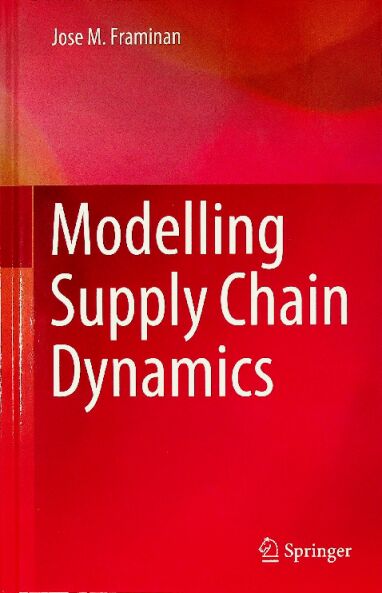
书名:Modelling supply chain dynamics
分类号:经济
页数:xvi, 216 pages :
摘要
This book discusses supply chain management, focusing on developments within modelling the dynamic behaviour of the supply chain. Aimed at postgraduate students, researchers and practitioners, this book provides an in-depth knowledge of the dynamics of supply chains. Business trends such as the globalisation process and the increase of competition across many industrial sectors have forced companies to concentrate on their core competences and to outsource those activities in which they do not excel. As a consequence, companies no longer produce and distribute their goods in isolation, but being part of a supply chain or supply network, i.e. a set of interrelated companies who ultimately deliver the goods and services to the final customer. Despite the prevalence of supply chains as the primary form of production and distribution, their performance can be seriously hampered by the complex dynamics resulting from the collaboration and coordination (or lack thereof) among their members.
This book provides the reader with modelling tools to understand, analyse and improve the dynamic behaviour of supply chains. It assembles seminal works on supply chain models and recent developments on the topic in order to provide a comprehensive, unified vision of the field for researchers and practitioners who wish to grasp the challenges of supply chain management. Aside presenting the main elements, equations and performance indicators governing the dynamics of a supply chain, and the book addresses issues such as the effect of timely and accurately sharing the information across members, the influence of restrictions on the productive capacities of their members, or the impact of the variability of the lead times, among others. Furthermore, more complex supply chain structures such as non-serial supply networks or closed-loop supply chains are modelled and discussed. Relevant managerial insights regarding the causes of supply chain underperformance, as well as avenues to improve their efficiency can be extracted from the resulting models.
查看更多
前言
In recent years, business trends such as the globalisation process and the increase of competition across many industrial sectors have forced companies to concentrate on their core competences and to outsource those activities in which they do not excel. As a consequence, companies no longer produce and distribute their goods in isolation, but being part of a supply chain or supply network, i.e. a set of interrelated companies who ultimately deliver the goods and services to the final customer. Nevertheless, despite the prevalence of supply chains as the primary form of production and distribution, their performance can be seriously hampered by the complex dynamics resulting from the collaboration and coordination (or lack thereof) among their members. As a result, discovering, understanding and mitigating these noxious effects have been a major concern among supply chain management professionals and academics, so the topic has evolved over the years to become a key area within the field.
This book is aimed at providing the reader with the basic modelling foundations to understand and analyse the dynamic effects induced in supply chains, most notably the bullwhip effect. It assembles seminal works on supply chain models and recent developments on the topic in order to provide a unified vision of the field for researchers and practitioners who wish to grasp one of the main challenges of supply chain management.
Given the focussed nature of the book, general topics in supply chain management are kept at a minimum, with the exception perhaps of Chap. 1 where more general issues are discussed. Therefore, the reader should not expect a proper coverage of topics such as inventory management, transportation and demand forecasting, which are treated here in a very light manner. Something similar happens with the mathematics and statistics involved in the models, although in this case several appendices have been included in order to make the book (almost) self-sufficient to understand the models developed. Nevertheless, given the extension of the field—Scopus search with the keyword "bullwhip effect" shows more than 1,400 records, with almost 400 in the last 5 years—it is not possible to present a comprehensive, detailed discussion of all the topics regarding the bullwhip effect. Instead, the main results are presented, and at the end of each chapter, it is included a section with further readings with many references.
Organisation of the Book
The book does not necessarily have to be read in a sequential order, although this would be perhaps the recommended course for those approaching the topic for the first time. It is structured into nine chapters and three appendices. In the first chapter, a general introduction to the supply chains and to the bullwhip effect is given. The activities in supply chain management that most influence the bullwhip effect are presented in Chap. 2. In Chap. 3, we discuss in-depth the bullwhip effect, recollecting his 'history' and pool of causes. Different indicators to measure the dynamics of the supply chain, both at the company level and a supply chain level, are also introduced in this chapter and given a precise definition. A basic model to represent supply chain dynamics is constructed on a step-by-step basis in Chap. 4, where the main hypotheses and limitations of the basic model are discussed. From this model, the quality of the information acquired by each node and the information transmitted to the rest of the nodes in the supply chain emerges as a key factor influencing its dynamic performance. In Chap. 5, this aspect is modelled and discussed in great detail, and information-related aspects are modelled and presented. In Chap. 6, the basic models presented in Chap. 4 are enriched by removing some hypotheses and including additional constraints in order to contemplate a wider range of scenarios observed in practice, including variable lead times or capacity constraints. Chapter 7 is devoted to modelling the dynamics of the so-called closed-loop supply chains, where there is a reverse flow of materials and information. In Chap. 8, the bullwhip effect related to the existence of non-linear supply chain structures is addressed. Finally, further topics within the area are discussed in Chap. 9.
Seville, Spain Jose M. Framinan
May 2021
查看更多
目录
1 Introduction to Supply Chains 1
1.1 Introduction 1
1.2 The Rise of Supply Chains 1
1.2.1 A Definition of Supply Chain 2
1.2.2 Factors Facilitating Supply Chains 4
1.2.3 Main Elements of a Supply Chain 5
1.3 New Problems, New Opportunities: The Bullwhip Effect 6
1.3.1 The Bullwhip Effect 7
1.3.2 Barriers to Overcome the Bullwhip Effect 10
1.4 Modelling Supply Chain Dynamics 10
1.5 Summary 11
1.6 Further Readings 12
References 12
2 Supply Chain Management 15
2.1 Introduction 15
2.2 Main Activities in SCM: The SCOR Model 16
2.3 Demand Modelling and Forecast 19
2.3.1 Demand Modelling 20
2.3.2 Forecasting Techniques 21
2.3.3 Other Forecasting Techniques 23
2.3.4 Measuring the Error in the Estimations 24
2.3.5 MMSE Estimation 25
2.4 Source: Inventory Management 29
2.4.1 Forecasting the Demand 34
2.4.2 Estimating the On-Hand Inventory 35
2.5 Summary 36
2.6 Further Readings 37
References 37
3 Supply Chain Dynamics 39
3.1 Introduction 39
3.2 The Dynamic Behaviour of a SC 40
3.3 Behavioural Causes 40
3.4 Operational Causes 42
3.5 Approaches to Mitigate the Bullwhip Effect 44
3.5.1 Behavioural Causes 45
3.5.2 Operational Causes 45
3.6 Performance Measures in SC/SCD 47
3.6.1 Measuring Order Variability 48
3.6.2 Measuring Inventory Variability 50
3.6.3 Slope Metrics 50
3.6.4 Other Metrics 52
3.7 Summary 53
3.8 Further Readings 53
References 54
4 Basic Models for SC Dynamics 57
4.1 Introduction 57
4.2 The Role of Modelling in OM/SCM 58
4.3 Elements of a Basic Supply Chain Model 58
4.4 Measuring the Bullwhip Effect 59
4.5 Putting All Pieces Together 60
4.5.1 Inventory Update 61
4.5.2 Work in process Update 62
4.5.3 Issuing the Order 62
4.5.4 Demand Estimates 65
4.5.5 A Simple Simulation Model 72
4.6 The Model at Supply Chain Level 73
4.6.1 An Expression of the BWE for a Two-and Three-Echelon SC 76
4.7 Implications of the Model: The Causes of Bullwhip Effect Revisited 79
4.8 Summary 80
4.9 Further Readings 80
References 81
5 The Effect of the Quality of Information in SCD 85
5.1 Introduction 85
5.2 Information Sharing 86
5.2.1 Expressing the Orders as a Function of the Customer Demand 88
5.2.2 Expressing the Orders Across the Supplier Lead Time as a Function of the Customer Demand 91
5.2.3 Orders Average and Standard Deviation for the No Info Sharing Scenario 92
5.2.4 Orders Average and Standard Deviation for the Info Sharing Scenario 93
5.2.5 The Impact of Information Sharing on Inventory 94
5.2.6 Using Past Orders to Forecast Demand 98
5.3 The Effect of Information Timeliness 101
5.3.1 Demand Estimate with Time-Lagged Data 101
5.3.2 The Error When Estimating with Time-Lagged Data 103
5.3.3 The Bullwhip Effect with Time-Lagged Data 104
5.4 Inaccuracies in the Inventory Information (IRI) 107
5.4.1 Shrinkage 108
5.4.2 Product Misplacement 111
5.4.3 Transaction Errors 113
5.5 Advance Demand Information 115
5.5.1 Perfect ADI in Make-to-Stock SCs 115
5.5.2 The Case of Imperfect ADI 116
5.6 Conclusions 116
5.7 Further Readings 117
References 119
6 Enriching SC Models 123
6.1 Introduction 123
6.2 Revisiting Some Hypotheses in the Basic SC Model 124
6.2.1 Backlogged Demand 124
6.2.2 Returned Orders 124
6.3 Variable Lead Times 127
6.3.1 Estimating Both Demand and Lead Times Using the Moving Average 130
6.3.2 Simulation Models 131
6.4 Order Crossover 132
6.5 Capacitated SCs 136
6.5.1 Modelling Capacity Limits 138
6.5.2 Workload-Dependent Lead Times 140
6.5.3 Combining Capacity Limitation with Load-Depending Lead Times 143
6.6 Conclusions 145
6.7 Further Readings 146
References 147
7 Closed-Loop Supply Chain 151
7.1 Introduction 151
7.2 Remanufacturing Scenarios 152
7.3 Market and Remanufacturing Visibility 154
7.3.1 Estimating the Flow of the Returns 155
7.4 Uncertainty in the Returns 157
7.4.1 No Consideration of the Return Flow 158
7.4.2 Estimation of the Return Flow 160
7.5 Conclusions 163
7.6 Further Readings 164
References 165
8 Modelling Complex SC Structures 167
8.1 Introduction 167
8.2 Several Retailers/Order Batching 168
8.2.1 Case 1: Independent Retailers 169
8.2.2 Case 2: Positively Correlated Orders 171
8.2.3 Comparing the Cases 173
8.3 Several Retailers with a Competing Market 174
8.3.1 Non-MMSE Estimations in a Competing Market 180
8.4 Conclusions 181
8.5 Further Readings 182
References 182
9 Further Issues in Modelling SC Dynamics 185
9.1 Introduction 185
9.2 Financial Considerations in SC Dynamics 185
9.3 Enhanced Forms of SC Collaboration 187
9.4 Supply Chain 4.0 188
9.5 Supply Chain Resilience and the Ripple Effect 189
9.6 Conclusions 190
References 191
Appendix A: Useful Calculus Formulae 195
Appendix B: Basic Probability Tools 197
Appendix C: Time Series Basics for Demand Modelling 209
Index 215
查看PDF
查看更多
作者简介
Jose M. Framinan is Full Professor in the Industrial Management Department at the School of Engineering in the University of Seville, Spain. His main research interests are related to Supply Chain and Operations management. He has published more than 90 papers in international refereed journals such as Computers & Industrial Engineering, Computers & Operations Research, European Journal of Operational Research, IIE Transactions, International Journal of Production Economics, International Journal of Production Research, International Journal of Systems Science, Journal of Heuristics, Journal of Materials and Processing Technology, Journal of the Operational Research Society, OMEGA, Operations Research Letters, OR Spectrum, and Production Planning & Control. He is or has been investigator in a number of international and national public- and private- funded projects. He currently serves as an Editor in Chief of the European Journal of Industrial Engineering, and Area Editor for the Flexible Services and Manufacturing Journals. He holds an Engineering and Doctor Engineering degree from the University of Seville.
查看更多
馆藏单位
中科院文献情报中心