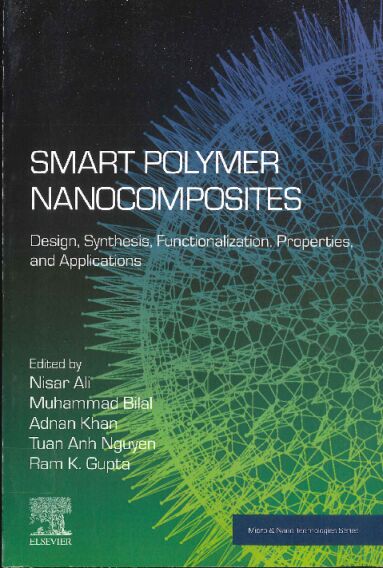
书名:Smart polymer nanocomposites
责任者: Nisar Ali ... [et al.].
分类号:一般工业技术
页数:xxxi, 620 p.
前言
A nanocomposite is a material composed of at least two immiscible phases, separated from one another by interface region. The material must contain the nanometer scale in at least one dimension in which the major component is called matrix, in which fillers are dispersed. Thus a matrix of nanocomposite is not only a continual phase, but it also stabilizes and significantly interacts with the nanomaterial. In this regard, for a nanocomposite matrix, polymers would be the ideal alternative. Polymers are mega or gigantic molecules made up of inorganic and mostly organic ingredients that are covalently joined between a huge number of tiny and basic repeating units. These repeating units are made up of simple molecules called monomers, and the process of converting them to polymers is known as polymerization. Additionally, the number of these kinds of units that repeat themselves is so large that the insertion or deletion of only a few polymer chain units does not affect the polymer's final characteristics. Then, the degree of polymerization means the number of repeating units in a molecule of polymer, and by using the known molecular mass of the repeating unit, the polymer's molecular weight is determined. Moreover, polymerization methods such as addition, condensation, and rearrangement are used to make these polymers. In addition to the polymerization process, monomers are joined together by covalent bonds one after the other to produce polymers without the removal of any by-products, and the chain growth mechanism is followed. Addition of polymerization comes in a variety of forms: traditional free radical polymerization; controlled radical polymerization, like transfer of group, atom transfer radical, nitroxide mediated, reversible addition fragmentation chain transfer, and so on; and ionic polymerization, such as cationic and anionic polymerizations, and so on. Polymers derived through these synthesis methods include polypropylene, polyethylene, poly(vinyl chloride), polystyrene, poly(methyl methacrylate), polyacrylonitrile, polybutadiene, polyisoprene, polychloroprene, poly (tetrafluoroethylene), and others as homopolymers, as well as copolymers such as ethylene-propylene, poly(styrene-butadiene), poly(acrylonitrile-butadiene), and poly (acrylonitrile-butadiene-styrene).
Homopolymers are polymers that have only one type of repeating unit, while polymers with many types of units that repeat are referred to as copolymers. Because of the internal plasticization effect, the creation of copolymers produces both flexible and rigid polymers, but it also creates numerous enhanced characteristics from the homopolymers individually. The term "addition polymer" refers to all polymers generated by the addition polymerization technique. The step-growth process is used to create polymers in the condensation polymerization process, where polycondensation reactions occur between mutually reactive reactants, resulting in the elimination of certain tiny molecules. These polymers contain lengthy chains with linear, low-branched, high-branched, and hyperbranched structures, and their length is quite long in comparison to their diameter, with the exception of the hyperbranched ones, which have an almost spherical shape. Hyperbranched polymers are three-dimensional exceptionally fanned (dendritic) macromolecules for certain missing branches (impeccably expanded globular such macromolecules are known as dendrimers), with countless sans surface useful gatherings, moderately low arrangement and liquefy viscosities, high similarity with others, and high dis-solvability in different solvents.
Furthermore, there are mainly three types of polymeric nanomaterials available: (1) polymeric nanomaterial based on natural substance-natural polymer is a renewable resource that may be obtained from a variety of places; that could be decomposed into H20, CO2, and inorganic tiny fragments; and it is also a substance that is ecologically benign. Physical and chemical approaches can be used to synthesize natural polymers with a variety of functional groups, or modified to create a novel material utilizing developing nanoscience. Natural polymer compounds that are frequently utilized nowadays include starch, chitosan, cellulose, alginate, chondroitin sulfate, and hyaluronic acid. (2) Biosynthesized polymer-based nanomaterial-enzyme hydrolysis is used to produce biosynthesized polymers (using microbial enzymes). Microbial polyesters and polysaccharides are found in these substances. Poly-hydroxybutyrate, poly(3-hydroxybutyrate-co-3-hydroxyvalerate), biofiber bundle, polyamino acid, and more examples are available. (3) Synthetic polymer-based nanomaterials-chemically synthesized polymer materials, such as PLGA, polyurethane, poly(methyl methacrylate), PLA, polyester, silicone rubber, polyvinylpyrrolidone, and polyvinyl alcohol. Since synthetic polymeric nanomaterials are well known for their unique properties (such as large surface-area-to-volume ratio, long-term stability, and low weight), a huge number of research is being carried out for the synthesis of such a material through various methods.
This book aims to shed more light on the morphologies of polymer and polymer composites, also stimuli-responsive surfaces. Furthermore, to discuss various applications of polymer nanoparticles, polymer composites such as sensing, targeted drug delivery, energy storage, separation, and purification. A total of 26 chapters of this book have been divided into three parts. Part I focuses on the fundamental concepts of smart polymer nanocomposites. Part II covers the tailoring of various polymeric nanocomposites, while Part III describes various applications of polymer nanostructures and polymer nanocomposites. The topics covered in Part I deal with the fundamentals of polymer nanocomposites (Chapters 1 -3) and their nanofibers (Chapter 4), synthesis (Chapter 5), and characterization (Chapter 6). Going ahead, Part II mainly covers the various types of smart polymer nanocomposites (Chapter 7), including magnetic nanocomposites (Chapter 8), graphene/CNTs-based nanocomposites (Chapter 9), thermo-responsive nanocomposites (Chapter 10), and thermosets-containing block copolymers nanocomposites (Chapter 11). In Part III, the emerging applications of smart polymer nanocomposites have been discussed in various fields, such as drug/bioactives delivery (Chapters 12 and 21), biomedicine (Chapters 13, 17, 19, and 23), sensing (Chapter 14), food-packaging (Chapters 15 and 16), electronic textiles (Chapter 18), energy storage (Chapters 20 and 26), automobile (Chapter 22), environmental remediation (Chapter 24), and flame-retardant nanocomposites (Chapter 24).
查看更多
目录
List of contributors xix
Preface xxix
Part I Basic principles
1 Introduction to polymeric nanomaterials 3
Kuruvalli Gouthami, Lavanya Lakshminarayana, Basheerabegum Faniband, V. Veeraraghavan, Muhammad Bilal, Ram Naresh Bhargava, Luiz Fernando Romanholo Ferreira, Abbas Rahdar, Siddappa Kakkameli and Sikandar I. Mulla
1.1 Introduction 3
1.2 Types of polymeric nanomaterials 5
1.2.1 Natural polymer-based nanomaterials 5
1.2.2 Chemically synthesized polymer materials 7
1.3 Methods for production of polymeric nanoparticles 8
1.3.1 Solvent evaporation 8
1.3.2 Emulsification/solvent diffusion 9
1.3.3 Emulsification/reverse salting-out 9
1.4 Applications of polymeric nanomaterials 10
1.4.1 In agriculture sector 11
1.4.2 In medical field 14
1.5 Current and future perspective 18
References 18
2 Polymer-based nanomaterials: an introduction 27
Gautam M. Patel, Vraj Shah, Jaydip Bhaliya, Pinaz Pathan and KM. Nikita
2.1 Nanomaterial introduction 27
2.1.1 Inorganic nanomaterials 27
2.1.2 Organic nanomaterials 28
2.1.3 Carbon-based nanomaterials 29
2.1.4 Composite-based nanomaterials 30
2.2 Introduction of polymeric nanomaterials: polymers, types of polymers, and polymeric nanomaterials 32
2.3 Various synthesis techniques for polymeric nanomaterials and its characterization 36
2.3.1 Solution casting-ultra sonication 36
2.3.2 Melt blending 41
2.3.3 In-situ polymerization 41
2.3.4 Electrospinning 42
2.3.5 Electrodeposition 42
2.4 Applications of polymeric nanomaterial in different fields 42
2.4.1 Coatings and paints 43
2.4.2 Biomedical 45
2.4.3 Sensors 47
2.4.4 Supercapacitors 48
2.4.5 Shape memory polymer composites 48
2.4.6 Packaging 48
2.5 Properties of polymeric nanomaterials 49
2.6 Conclusion and future perspectives 50
References 51
3 Smart polymeric nanocomposites: synthesis and applications 61
Bilal Akram, Rana Farhat, Ahmed Shjua and Javeed Akhtar
3.1 Introduction 61
3.2 Some novel polymeric nanocomposites 62
3.2.1 Nanocomposite materials containing petroleum-based polymers 62
3.2.2 Biopolymer based nanocomposites 62
3.2.3 Sol-gel ceramics 65
3.2.4 Fillers in elastomers 65
3.2.5 Polymer-modified ceramics 66
3.2.6 Polymer/silica nanocomposites 67
3.2.7 Plasmonic polymeric nanocomposites 71
3.2.8 Ferroelectric polymer-based nanocomposites 75
3.3 Applications of polymeric nanocomposites 78
3.3.1 Drug delivery applications 78
3.3.2 Tissue engineering applications 79
3.3.3 Photothermal applications 81
3.3.4 Water purification applications 83
3.3.5 Sensor applications 84
3.3.6 Energy storage applications 85
3.3.7 Optical applications 86
3.4 Conclusions 87
References 87
4 Organic and inorganic nanoparticles 93
Ehsan Ullah Rashid, Shahid Nawaz, Junaid Munawar, Aniruddha Sarker, Shahid Hussain, Hafiz M.N. Iqbal and Muhammad Bilal
4.1 Introduction 93
4.2 Organic nanoparticles 94
4.3 Generally recognized as safe nanoparticles 94
4.4 Polysaccharides-based nanoparticles 94
4.5 Protein-based nanoparticles 95
4.6 Lipids-based nanoparticles 96
4.7 Micelle 96
4.8 Liposomes 97
4.9 Dendrimers 98
4.10 Synthesis approaches for organic nanoparticles 99
4.11 Self-assembly 99
4.12 Nanoprecipitation 100
4.13 Coordination dependent self-assembly 100
4.14 Thin-film hydration-based self-assembly 100
4.15 Emulsification 101
4.16 Precipitation induced by solvent removal 101
4.17 Solvent evaporation method 101
4.18 Salting out 102
4.19 Gelation of the emulsion droplets 102
4.20 Emulsion polymerization 102
4.21 Conventional emulsion polymerization 103
4.22 Surfactant-free emulsion polymerization 103
4.23 Interfacial polymerization 103
4.24 Controlled/living radical polymerization 103
4.25 Inorganic nanoparticles and their applications 103
4.26 General strategies for the synthesis of uniform inorganic nanoparticles 104
4.27 Synthesis of metallic nanoparticles by different methods 104
4.27.1 Synthesis of gold nanoparticles 104
4.28 Method for preparation of iron oxides nanoparticles 105
4.29 Synthesis of magnetic nanoparticles by decomposition in organic media 105
4.30 Synthesis of quantum dots 105
4.31 Synthesis of carbon nanotubes by electric arc discharge method 106
4.32 Magnetic nanoparticles 106
4.33 Metallic inorganic nanoparticles 107
4.34 Gold nanoparticles 108
4.35 Silver nanoparticles 108
4.36 Iron oxide nanoparticles 109
4.37 Quantum dots 109
4.38 Carbon-based nanomaterial like carbon nanotubes 111
4.39 Conclusion 112
References 112
Further reading 119
5 Precipitation polymerization 121
Sabir Khan, Jaime Vega-Chacon, Gerson A. Ruiz-Cordova, Charles Pizan-Aquino, Eduardo EJ Jara-Cornejo, Sergio Espinoza Torres, C. Jacinto-Hernandez, Rosario Lopez, Maria D.P.T. Sotomayor, Gino Picasso and Javier E.L. Villa
5.1 Precipitation polymerization 121
5.2 Synthesis (choice of precursor), controlled radical precipitation polymerization, photopolymerization 123
5.3 Self-stabilized precipitation polymerization 126
5.3.1 2SP Stability mechanism of polymerization 127
5.3.2 Nucleation and growth mechanism in 2SP polymerization 128
5.4 Application, merits, and demerits 128
5.5 Conclusions 132
References 133
6 Characterization of polymeric nanoparticles 141
Sabir Khan, Ademar Wong, Shakeel Zeb, Bianca Mortari, Javier E.L. Villa and Maria D.P.T. Sotomayor
6.1 Introduction 141
6.2 Particle size, distribution, agglomeration, and shape: transmission electron microscopy, scanning electron microscopy, and atomic force microscopy 142
6.3 Composition and structure 145
6.4 Charge on the surface: zeta potential 149
6.5 Crystallographic structure 151
6.6 Discovery of nuclear magnetic resonance spectroscopy 151
6.7 Differential scanning calorimetry & thermal stability 154
6.8 Conclusion 155
References 156
Part II Tailoring of various polymeric
7 Polymer nanocomposites: an overview 167
Idrees Khan, Ibrahim Khan, Khalid Saeed, Nisar Ali, Noor Zada, Adnan Khan, Farman Ali, Muhammad Bilal and Mohammed Salim Akhter
7.1 Introduction 167
7.2 Classification of polymer nanocomposites 171
7.3 Preparation of polymer nanocomposites 171
7.3.1 In situ polymerization 172
7.3.2 Solution dispersion or solution mixing 172
7.3.3 Melt extrusion 173
7.4 Properties of polymer nanocomposites 173
7.5 Application and advantages of polymer nano-composites 174 7.5.1 Energy and electrical applications 175
7.5.2 Medical applications 175
7.5.3 Environmental applications 176
7.5.4 Sensing applications 177
7.6 Conclusion 178
References 178
8 Magnetic iron oxide nanocomposites: types and biomedical applications 185
Nafeesa Sarfraz, Ibrahim Khan, Idrees Khan, Muhammad Ashraf, Muhammad Ayaz, Khalid Saeed, Nisar Ali and Muhammad Bilal
8.1 Introduction 185
8.2 Magnetic iron oxide nanocomposites 186
8.2.1 Magnetic iron oxides nanoparticles/polymer nanocomposites 187
8.2.2 Magnetic iron oxides nanoparticles/silica nanocomposites 187
8.2.3 Magnetic iron oxides nanoparticles/clay nanocomposites 189
8.2.4 Magnetic iron oxides nanoparticles/carbon material nanocomposites 189
8.2.5 Miscellaneous magnetic iron oxides-nanocomposites 191
8.3 Applications of magnetic iron oxide-based nanocomposites 192
8.3.1 Magnetic iron oxides nanocomposites in targeted drug delivery applications 192
8.3.2 Magnetic iron oxide nanocomposites as effective therapeutic agents 193
8.3.3 Magnetic iron oxide nanocomposites for immunotherapy applications 194
8.3.4 Magnetic iron oxide nanocomposites for cancer treatment applications 195
8.4 Conclusion 196
Acknowledgment 197
References 197
9 Graphene and carbon nanotubes-based polymer nanocomposites 205
Khalid Saeed, Idrees Khan, Ibrahim Khan, Nisar Ali, Muhammad Bilal and Mohammed Salim Akhter
9.1 Introduction 205
9.2 Polymer based nanocomposite 206
9.3 Graphene 206
9.4 Preparation of graphene-polymer nanocomposites 207
9.5 Solution blending 207
9.6 Melt mixing 208
9.7 In situ polymerization 208
9.8 Dispersion of graphene or carbon nanotubes in matrix 209
9.8.1 Mechanical dispersion 209
9.8.2 High-speed ball milling 210
9.9 Non-covalent chemical modification 212
9.10 Properties of polymer nanocomposite 212
9.11 Applications of polymer nanocomposite 213
9.12 Energy and electronic devices applications 214
9.13 Biomedical applications 214
9.14 Filtration membrane 214
9.15 Organic pollutants remediation 215
9.16 Conclusion 215
References 215
10 Thermo-responsive functionalized polymeric nanocomposites 219
Atta Rasool, Muhammad Rizwan, Anees ur Rehman Qureshi, Tahir Rasheed and Muhammad Bilal
10.1 Polymer nanocomposites 219
10.2 Nanofiller or reinforcement material 219
10.2.1 Organic and inorganic nanofillers 220
10.2.2 Inert and active nanofillers 220
10.3 Surface modification of nanofiller 220
10.4 Smart materials 220 10.4.1 Historical evolution of small materials 221
10.5 Stimuli and its classification 221
10.5.1 Chemical and physical stimuli 222
10.5.2 Endogenous and exogenous stimuli 222
10.6 Thermo-responsive nanocomposites 222
10.6.1 Upper critical solution temperature 222
10.6.2 Lower critical solution temperature 222
10.6.3 Responses stimulated by temperature stimulus 223
10.6.4 Synthetic methods 226
10.6.5 Graphene based thermo-responsive nanomaterials 227
10.6.6 Thermo-responsive hydrogels 228
10.6.7 Thermo-responsive polymeric nanomaterials 230
10.6.8 Applications of thermo-responsive nanocomposites 230
10.7 Conclusions 233
References 234
11 Nanostructured thermosets containing block copolymers and carbon nanotubes 241
Muhammad Adeel, Mohsin Raza, Ghulam Yasin, Abbas Rahdar and Muhammad Bilal
11.1 Thermosets 241
11.2 Morphologies of thermosets containing block copolymers 242
11.3 Influencing factors of nanostructure in the thermosets 246
11.3.1 Composition of block copolymers 246
11.3.2 Topologies of block copolymers 246
11.3.3 Molecular weights and contents of block copolymers 248
11.3.4 Curing agents and curing conditions 249
11.4 Nanostructured thermosets containing inorganic nanofillers 251
11.5 Properties of nanostructured thermosets 252
11.5.1 Thermal properties 252
11.5.2 Mechanical properties 253
11.5.3 Surface properties 253
11.5.4 Dielectric properties 253
11.6 Conclusion 254
References 255
Part III Applications of polymer nanostructures and polymer nanocomposites
12 Conductive polymers for drug and bioactives delivery 263
Pratap Basim, Srinivas Ajjarapu and Mallesh Kurakula
12.1 Introduction 263
12.2 Classification of conductive polymers for pharmaceutical perspective 265
12.3 Advantages and limitations of conductive polymers 266
12.4 Conductive polymers as a green material in drag delivery 268
12.5 Conductive polymers as a green material in bioactive delivery 269
12.6 Challenges in the utilization of conductive polymers for medical applications 271
12.7 Future prospects 272
12.8 Conclusion 273
References 273
13 Polymer nanocomposites for biomedical applications 279
Ezzat Khan, Shahab Khan and Abdullah Khan
13.1 General 279
13.2 Important properties of polymer composite materials for biomedical applications 280
13.2.1 Physiochemical and mechanical properties 280
13.2.2 Biodegradability 280
13.2.3 Structure of polymer composite materials 281
13.3 Hydrogels for wound dressing and healing 282
13.4 Antimicrobial potentials of polymer composite materials 288
13.5 Polymer composite materials in cancer therapy 289
13.6 Regenerative and other medicines 293
13.7 Bone regeneration and artificial tissues 295
13.7.1 Miscellaneous applications 297
References 298
14 Polymer nanocomposites for sensing applications 305
Ezzat Khan
14.1 Introduction 305
14.1.1 Important properties of materials as sensors 305
14.2 Applications in everyday life 306
14.2.1 Carbon dioxide sensors 306
14.2.2 Carbon monoxide sensors 309
14.2.3 Nitrogen oxide sensors 312
14.2.4 Sulfur oxides, SOx sensors 313
14.2.5 H2S sensors 316
14.2.6 Ammonia sensors 320
14.2.7 Polymer nanocomposites as glucose sensors 322
14.2.8 Miscellaneous sensors 325
14.3 Conclusion 327
References 327
15 Polymer nanocomposites for food-packaging applications 333
Tran Hong Thang and Tuan Anh Nguyen
15.1 Introduction 333
15.1.1 Food-packaging applications 333
15.1.2 Polymer nanocomposites 335
15.2 Smart packaging applications 339
15.2.1 Active packaging applications 340
15.2.2 Responsive packaging applications 344
15.3 Conclusions and future perspective 349
References 349
16 Prospects and challenges of polymer nanocomposites for innovative food packaging 355
Aniruddha Sarker, Shakti Chandra Mondal, Raju Ahmmed, Juwel Rana, Most. Waheda Rahman Ansary and Muhammad Bilal
16.1 Introduction 355
16.2 Prospect of polymer nanocomposites in food packaging 356
16.3 Functional application of nanocomposites 358
16.4 Classification of nanocomposites 360
16.4.1 Classification of polymer nanocomposites 360
16.4.2 Classification based on nanofiller dimensions 361
16.4.3 Classification based on nanofiller types (Fig. 16.4) 362
16.4.4 Classification based on type of polymer matrix (Fig. 16.5) 362
16.4.5 Classification based on method of synthesis (Fig. 16.6) 363
16.4.6 Polymer nanocomposites in food packaging application 363
16.5 Fabrication of nanocomposites 366 16.5.1 Nanoemulsions 366
16.5.2 Nanoliposomes 366
16.5.3 Nanohydrogens 367
16.5.4 Lipid nanoparticles 368
16.6 Impact of nanopackaging on food quality and shelf life 368
16.7 Practical challenges of nanocomposites application in food packaging 369
16.8 Technological advancement to enhance nanocomposite for food packaging 370
16.9 Research perspective to overcome the prevailing limitation of nanocomposites 371
16.10 Conclusions 372
References 372
17 Polymer nanocomposites for biomedical applications 379
Areej Shahbaz, Nazim Hussain, Tehreem Mahmood, Hafiz M.N. Iqbal, Talha Bin Emran, Pau Loke Show and Muhammad Bilal
17.1 Introduction 379
17.2 Polymer nanocomposite systems 380
17.2.1 Polymer carbon-nanotubes 380
17.2.2 Polymer graphene 382
17.2.3 Metal composites as polymer nanocomposites 382
17.3 Biomedical applications of graphene-based polymer nanocomposites 383
17.4 Biomedical applications of carbon-based polymer nanocomposites 384
17.5 Biomedical applications of metal-based polymer nanocomposites 385
17.6 Hydroxides structures for biomedical applications 386
17.7 Ceramic polymer composites for biomedical application 387
17.8 Piezoelectric composites for biomedical applications 387
17.9 Biomedical applications of nanoclays 388
17.10 Challenges 389
17.11 Conclusion 389
References 390
18 Smart electronic textiles 395
Sania Naseer, Uzma Jabeen, Muhammad Aamir, Shuja Ahmed and Javeed Akhtar
18.1 Introduction 395
18.1.1 History 396
18.2 Fabrication of smart textiles 397
18.2.1 Conductive polymers 397
18.2.2 Conductive yarns and fibers 398
18.2.3 Conductive polymer composites 400
18.3 Sensors- and actuators-based textiles 403
18.3.1 Integration and networking 403
18.3.2 Design and interactive designs 403
18.4 Properties of smart e-textiles 403
18.4.1 Physiochemical properties of smart e-textiles 404
18.4.2 Electrical properties of smart e-textiles 404
18.5 Methods of integration in smart e-textiles 405
18.6 Applications of smart e-textiles 405
18.6.1 Applications in medical 405
18.6.2 Surgery 406
18.6.3 Healthcare 406
18.6.4 Military and defense 406
18.6.5 Fashion 407
18.7 Future perspective of smart e-textiles 408
18.8 Conclusions 408
References 409
19 Application of polymer nanocomposites in biomedicine 413
Linlu Zhao and Junqiu Liu
19.1 Introduction 413
19.2 Functional polymer nanocomposites 414
19.2.1 Amphiphilic polymer nanocomposites 414
19.2.2 Hybrid polymer nanocomposites 415
19.2.3 Stimuli-responsive polymer nanocomposites 418
19.3 Bioimaging applications of the functional polymer nanocomposites 420
19.3.1 Polymer nanocomposites for fluorescent imaging 420
19.3.2 Polymer nanocomposites for photoacoustic imaging 422
19.4 Therapeutic applications of the functional polymer nanocomposites 423
19.4.1 Polymer nanocomposites for photodynamic therapy 423
19.4.2 Polymer nanocomposites for photothermal therapy 424
19.4.3 Polymer nanocomposites for targeted drug delivery 425
19.4.4 Polymer nanocomposites for imaging-guided theranostics 427
19.5 Summary 428
Reference 429
20 Polymer nanocomposites for dielectric and energy storage applications 435
Shoomaila Latif, Fatima Izhar, Muhammad Imran, Nazim Hussain and Muhammad Bilal
20.1 Polymer nanocomposites 435
20.2 Classification of polymers 435
20.3 Dispersed phase in polymer nanocomposites "nanofillers" 436 20.3.1 Types of nanofillers 437
20.4 Role of nanofillers in polymer nanocomposites 437
20.5 Applications of polymer nanocomposites 437
20.6 Polymer nanocomposites for dielectric applications 438
20.6.1 Dielectric and dielectric materials 438
20.6.2 Capacitance of dielectric materials 439
20.6.3 Dielectric permittivity 439
20.6.4 Types of dielectric materials 439
20.6.5 Need for dielectric energy storage 440
20.6.6 Breakdown theory of dielectric materials 441
20.6.7 Mechanisms causing break down of dielectric materials 442
20.6.8 Polarization 443
20.6.9 Polymer nanocomposites for dielectric applications 443
20.6.10 Multicore model 445
20.6.11 Low density polyethylene breakdown strength 445
20.6.12 Different types of polymer nanocomposites for enhanced dielectric properties 445
20.6.13 Surface modification techniques for enhancing interaction between nanoparticles and polymer matrix 449
20.6.14 Percolation theory to explain increase in dielectric permittivity 449
20.7 Polymer nanocomposites for energy storage applications 450
20.7.1 Lithium-ion batteries 450
20.7.2 Li/S batteries 451
20.7.3 Electrochemical capacitors 451
20.8 Conclusions 452
References 452
21 Polymer nanocomposites for drug delivery applications 461
Seema Panicker and Ahmed A. Mohamed
21.1 Introduction 461
21.2 Nanoparticles for drug delivery 462
21.3 Cellular uptake of nanoparticles 462
21.4 Polymer-ceramic nanocomposites for drug delivery applications 463
21.5 Type of ceramic nanophases 463
21.6 Ceramic nanocomposites as drug carriers for bone diseases 464
21.7 Ceramic nanoparticles for cancer treatment 464
21.8 Natural polymeric nanomaterials 465
21.9 Polysaccharides-based polymers 465
21.10 Protein-based polymers 466
21.11 Co-natural polymer-based nanoparticles 466
21.12 Synthetic nanopolymers and drug delivery applications 467
21.13 Conclusion 468
References 469
22 Polymeric nanocomposites for automotive application 473
Francisco Nunes de Souza Neto, Gabriella Ribeiro Ferreira, Thiago Sequinel, Glenda Biasotto, Sandra Andrea Cruz, Jessica Caroline Ferreira Gimenez, Roger Goncalves, Carlos Henrique Scuracchio, Caio Marcio Paranhos da Silva, Emerson Rodrigues Camargo, Gustavo Villela Rodrigues, Cezar Augusto da Rosa and Luiz Fernando Gorup
22.1 Introduction 473
22.2 Market value for polymer nanocomposites 474
22.3 Overview of the several methods to obtain polymer-clay nanocomposites 475
22.4 Definitions, types of matrices, and fillers 480
22.5 Applications of composites and nanocomposites in the automobile industry 485
22.6 General conclusions and future perspectives 493
References 493
23 Silica-based polymer nanocomposites and their biomedical applications 507
Manahil Bakhtiar, Farman Ali, Nisar Ali, Shaukat Saeed, Mohammad Mansoob Khan, Sami Rtimi, Pau Loke Show and Muhammad Bilal
23.1 Introduction 507
23.1.1 Polymer-based nanocomposites 508
23.1.2 Non-polymer-based nanocomposites 510
23.1.3 Polymer based-nanocomposites 510
23.1.4 Types of polymer nanocomposites 510
23.1.5 Preparation of polymer nanocomposites 511
23.1.6 Solution mixing 512
23.1.7 Melt blending 512
23.1.8 In situ polymerization 512
23.1.9 Template synthesis 513
23.1.10 Applications of polymer nanocomposites 513
23.1.11 Silica-based polymer nanocomposite 516
23.1.12 Synthesis of silica-based polymer nanocomposites 517
23.1.13 Silica-based epoxy-nanocomposites materials 518
23.1.14 Silica-based polymer-nanodielectric composite 518
23.1.15 Silicon-based nanoclay polymer nanocomposites 519
23.1.16 Silicon-based graphene polymer composites 519
23.1.17 Recent developments in silica-based polymer nanocomposites 519
23.1.18 Applications of silica-based polymer nanocomposites 522
23.1.19 Catalysis or catalytic activity 522
23.1.20 Biomedical field 523
23.1.21 Coatings 523
23.1.22 Proton-exchange-membranes 523
23.1.23 Food packaging 524
23.1.24 Biosensors 524
23.1.25 Future prospects 525
23.2 Conclusion 525
References 526
24 Natural polymer-based nanostructures and their applications 529
Sumeet Malik, Adrian Khan, Nisar Ali, Abbas Rahdar, Ghulam Yasin, Shahid Hussain and Muhammad Bilal
24.1 Introduction 529
24.2 Classes of natural polymers 530
24.2.1 Chitosan 531
24.2.2 Starch 532
24.2.3 Pectin 532
24.2.4 Gelatin 532
24.3 Nanostructures based on natural polymers 533
24.4 Applications of nanostructures based on natural polymers 533
24.5 Conclusion 535
Acknowledgments 537
References 537
25 Nanocomposite-based flame-retardant polyurethane foams 543
Magdalene A. Asare, Felipe M. de Souza, Vishwa D. Suthar and Ram K. Gupta
25.1 Introduction 543
25.2 Types of flame-retardants 547
25.2.1 Halogenated flame retardants 548
25.2.2 Nitrogen-based flame retardants 549
25.2.3 Phosphorus-based flame retardants 551
25.2.4 Inorganic and miscellaneous flame retardants 552
25.3 Metal oxide/sulfide-based flame-retardants 552
25.3.1 Transition metal chalcogenides 553
25.3.2 Transition metal oxides 553
25.3.3 Copper-based flame retardants 555
25.3.4 Titanium oxide 556
25.3.5 Antimony trioxide 556
25.3.6 Zinc borate 557
25.3.7 Zinc oxide 557
25.3.8 Nickel oxide and derivatives 557
25.3.9 Steel slag 558
25.3.10 Metal oxides and hydroxides 558
25.3.11 Silicon-based flame-retardants 559
25.3.12 Metal-organic frameworks 562
25.3.13 Metal-phenolic network 563
25.4 Conclusion and outlook 564
References 565
26 Recent development in polymer nanocomposites for energy storage applications 571
Felipe M. de Souza, Jonghyun Choi and Ram K. Gupta
26.1 Introduction 571
26.2 Types of energy devices and their working principle 573
26.3 Polymer nanocomposites for supercapacitors 575
26.3.1 Conducting polymer and carbon-based nanocomposites for supercapacitors 575
26.3.2 Conducting polymer and transition metal oxides based nanocomposites for supercapacitors 577
26.3.3 Conducting polymer and transition metal chalcogenide-based nanocomposites for supercapacitors 579
26.4 Polymer nanocomposites for batteries 581
26.4.1 Conducting polymer and carbon-based nanocomposites for batteries 581
26.4.2 Conducting polymer and metal oxide-based nanocomposites for batteries 582
26.4.3 Conducting polymer and chalcogenides based nanocomposites for batteries 584
26.5 Polymer nanocomposites for flexible devices 586
26.6 Conclusion and outlook 591
References 592
Index 597
查看PDF
查看更多
馆藏单位
中国化工信息中心