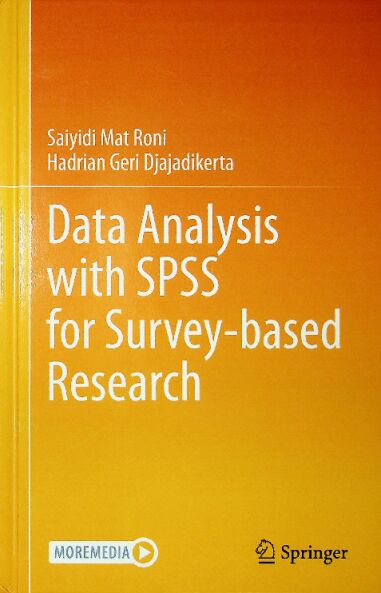
书名:Data analysis with SPSS for survey-based research
责任者:Saiyidi Mat Roni | Hadrian Geri Djajadikerta.
分类号:社会科学总论
页数:xv, 264 pages :
摘要
This book is written for research students and early-career researchers to quickly and easily learn how to analyse data using SPSS. It follows commonly used logical steps in data analysis design for research. The book features SPSS screenshots to assist rapid acquisition of the techniques required to process their research data.
Rather than using a conventional writing style to discuss fundamentals of statistics, this book focuses directly on the technical aspects of using SPSS to analyse data. This approach allows researchers and research students to spend more time on interpretations and discussions of SPSS outputs, rather than on the mundane task of actually processing their data.
查看更多
前言
We write this book with three groups of researchers in mind – the early career researchers who need a quick guide to run stats on their data, prolific researchers who want to have a glance into which stats to use (while completing their research grant proposals), and research supervisors who want to check if their research students are using the right tool. This book is a product of statistical workshops and research consultations conducted over many years, and the challenges we have experienced in our supervisions of research students. We provide quick guides into why, how, and when to use a given statistical test. We put "quick" in italic for a reason. It is because we introduce our readers to concepts of each statistical test, and we walk you through the necessary steps to run the suitable test of your choice in SPSS.
There are many statistical books and SPSS in the market. Ours is another addition to the plethora, but with a different tangent. From our experience, we have mostly failed to convince many that stats is fun. The moment we introduced the alien Greek characters and artistic stats formula, we saw our audience started to frown, adding 10 years to their look. If you feel the same way, you are not alone. Therefore, rather than ageing your look (and losing our audience), what we do in this book is to have more pictures than words, more plain words than stats jargons, and more jokes than ordinary academic textbooks. We want to interact with our readers, hence our style of writing. Intentionally, this reduces your anxiety in stats, especially if you are an early career researcher. As much as possible, we use and reuse similar datasets within the same research settings for our examples so that our readers can focus on the stats rather than spending extra time to understand the context of the data.
Our book teaches you the stats so that you can successfully complete your research journey. Our intention is not to train you to become a statistician. It is like driving. We want you to confidently drive a BMW, but we do not intend to train you to be an automobile engineer. It is sufficiently good to know what the steering wheel is for and when to use the turn-signal (that blinking orange light that you use to tell others that you are turning left or right). However, if you want to build a turbo engine for your BMW, you need to take more training. By the way, we have no intention to say that driving a BMW is totally different from driving other cars. We just use a BMW example because we both like the car.
Our book has three main parts. The first part is about designing a survey. This tells you about the concept of latent variables, sample size, and SPSS basics. If this is the first time you are doing survey-based research, Chap. 1 and 2 are a must.
The second part of our book is the preliminary data analysis which is explained in Chap. 3 and extended to Chaps. 4, 5, and 6. This is when you start cleaning your data after you have collected it and run a few stats to see if your data is sufficiently good for your actual analyses to answer your research questions. We arrange the chapters and parts chronologically, which means these chapters walk you through the most common stages of processing your dataset.
The third and final part of our book, which runs from Chaps. 7, 8, 9 and 10, is a battery of tests you can use to test your hypotheses. Not all of them, of course. We also sneak in two subsections in Chap. 9 (regression). These are bootstrap and quantile regressions. These classes of stats can be a chapter of their own because they are special. But we decide to introduce them at this stage. Perhaps, we will write another book specifically for bootstrap and quantile regression.
We hope you enjoy reading our book, and have a safe and fun stats journey.
Joondalup, WA, Australia Saiyidi Mat Roni
Hadrian Geri Djajadikerta
查看更多
目录
1 Research Instrument Design and Sample 1
1.1 Survey 1
1.1.1 Working with Directly Observed Variables 2
1.1.2 Designing Questions for Latent Variables 4
1.2 Sample Size 5
References 7
2 SPSS Basics 9
2.1 Data and Variable Views 9
2.2 Output Window 12
2.3 SPSS Syntax 13
3 Preliminary Data Analysis: An Analysis Before the Analysis 15
3.1 Cleaning up Your Data: Monotone 20
3.2 Polishing Your Data: Missing Values and Outliers 23
3.2.1 Identifying and Recoding Missing Values 23
3.3 Missing Values Analysis (MVA) 29
3.3.1 Multiple Imputation (MI) 30
3.3.2 Expected Maximisation (EM) 36
3.3.3 Identifying and Treating Outliers 39
3.4 Normal Distribution 44
3.5 Data Transformation 50
References 53
4 Factor Analysis: Combining Related Question-Items into Latent Variables 55
References 66
5 Assess the Quality of Your Instrument 69
5.1 Reliability 70
5.2 Validity 76
References 88
6 Latent Variable 89
6.1 Addressing Biases 94
6.1.1 Non-Response Bias 94
6.1.2 Common Method Bias 98
References 104
7 Test of Differences Among Groups 105
7.1 t-Test: Testing Differences Between Two Groups 105
7.1.1 Independent Samples t-Test 106
7.1.2 Paired Samples t-Test 112
7.2 ANOVA: Testing More than Two Groups 119
7.3 ANCOVA: Testing Differences and Controlling for Covariate 126
References 142
8 Test of Correlations 143
8.1 Pearson Correlation 144
8.2 Pearson Correlation with Bootstrap 156
References 160
9 Regression 161
9.1 Simple Regression 163
9.1.1 Regression with Bootstrap 176
9.1.2 Quantile Regression 179
9.2 Multiple Regression 187
9.3 Hierarchical Multiple Regression 199
References 217
10 Non-Parametric Tests 219
10.1 Mann-Whitney U 219
10.2 Kruskal-Wallis 226
10.3 Jonckheere-Terpstra 233
10.4 Chi-Square 240
10.5 Wilcoxon's Sign Rank 246
10.6 Spearman Rho and Kendall Tau Correlation 253
References 260
Bibliography 261
Index 263
查看PDF
查看更多
作者简介
Hadrian Geri Djajadikerta is associate professor of strategic management accounting in the School of Business and Law at Edith Cowan University, Perth, Australia. He has over two decades of research, teaching, and leadership in academia and has supervised many doctoral students to completion. His research focuses on strategic management accounting, behavioural accounting, sustainability reporting, corporate governance, and corporate social responsibility.
查看更多
馆藏单位
中科院文献情报中心