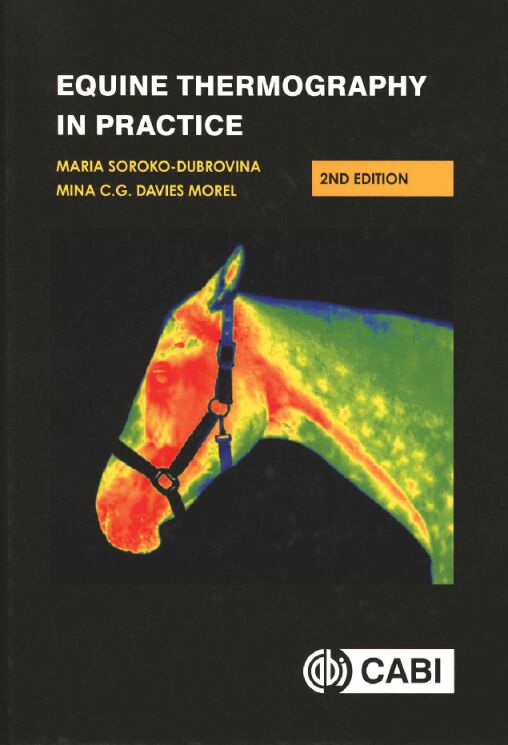
书名:Equine thermography in practice
责任者:Maria Soroko-Dubrovina | Mina C.G. Davies Morel.
ISBN\ISSN:9781800622890,9781800622906
分类号:农业科学
版次:2nd ed.
页数:xv, 113 pages
摘要
Equine Thermography in Practice is a compendium of the practical application of thermography to equine veterinary medicine and rehabilitation. Currently, thermography is one of the most rapidly evolving equine diagnostic tools. Intensive training of horses is associated with significant physical demands on the musculoskeletal system, contributing to a high incidence of injury. Injury causes changes in blood circulation and thereby changes in body surface temperature. Thermography can detect these changes in body surface temperature and hence can be used to diagnose and monitor injury, disease and work overload of the musculoskeletal system.
This book aims to provide a valuable source of reference for equine therm-ographers, veterinarians, equine therapists and body manipulators, as well as farriers, equine podiatrists, saddlers, riders, trainers and other paraprofessionals in the equine industry. As a reference textbook, it will also prove useful to students of veterinary medicine, animal/equine science and husbandry, as well as students of other courses where equine science is studied.
This book is the first publication on the equestrian book market that extensively discusses equine thermography issues and its use in equine diagnosis.
In this second edition, text has been updated throughout with new references and additional illustrative case studies.
If you have any comments, suggestions or queries concerning this book, please contact Maria Soroko-Dubrovina by e-mail at kontakt@eqma.pl. Any feedback is very much appreciated.
All figures and tables belong to the authors. Figure 1.8a'b is used with permission from Kevin Howell. Figure 4.12 is used with permission from Paulina Zielinska.
查看更多
目录
About the Authors ix
Glossary xi
Introduction xv
1 Principles of Equine Thermography 1
1.1. Thermography 1
1.2. Methods for Measuring Infrared Radiation 2
1.3. Principles of Infrared Radiation 2
1.4. The Thermographic Image 4
1.5. Thermographic Imaging Technology 6
1.6. Thermography as a Diagnostic Tool in Equine Medicine 7
1.7. Normal Body Surface Temperature Distribution of the Horse 9
1.7.1. Anatomical structure 9
1.7.2. Subcutaneous tissue 9
1.7.3. Muscle tissue 10
1.7.4. Hair coat 10
1.7.5. Season of the year 11
2 Fundamentals of Thermographic Examination 13
2.1. Procedures for Thermographic Examination, Including the Impact of Environmental Conditions 13
2.1.1. Preparing a room for thermographic examination 13
2.1.2. Preparing a horse for thermographic examination 15
2.1.3. Interview with the horse owner 18
2.2. Taking Images of the Horse 18
2.2.1. Thermographic protocol 19
2.2.2. Correct positioning of the horse and camera 19
2.2.3. Sample thermographic images 21
2.2.3.1. Lateral aspect of the horse 22
2.2.3.2. Distal forelimbs 22
2.2.3.3. Distal hindlimbs 23
2.2.3.4. Shoulder area 23
2.2.3.5. Croup area 24
2.2.3.6. Chest area 24
2.2.3.7. Neck area 25
2.2.3.8. Head area 26
2.2.3.9. Back area 27
2.3. Most Frequently Made Errors in Thermographic Imaging 27
3 Interpretation of Thermographic Images and the Normal Superficial Temperature Distribution of the Horse 28
3.1. Thermography Analysis for Veterinary or Prophylactic Purposes 28
3.2. Analysis of Symmetry and Repeatability of Body Surface Temperature Distribution in Contralateral Body Areas of the Horse 28
3.2.1. Determination of body surface temperature differences between symmetrical body areas or regions of interest 29
3.2.2. Determination of body surface temperature along linear ROIs or at specific points on the body surface 30
3.2.3. Interpretation of thermograms 31
3.2.3.1. Distal forelimbs and hindlimbs 33
3.2.3.2. Back area 36
3.2.3.3. Shoulder area 38
3.2.3.4. Neck area 38
3.2.3.5. Head area 39
3.2.3.6. Croup area 40
3.2.3.7. Chest area 41
3.2.4. What should be considered in thermographic image interpretation? 41
3.2.5. Thermographic reports 48
4 Development of Equine Thermography and Its Use in Equestrianism 50
4.1. Development of Thermography in Equine Veterinary Medicine 50
4.2. Use of Thermography in Equestrianism 58
4.2.1. Use of thermography to monitor horse welfare 58
4.2.2. Use of thermography to assess saddle fit 60
4.2.3. Use of thermography to assess hoof function 62
4.3. Use of Thermography to Assess Racing Performance 66
5 Use of Thermography in Physiotherapy 69
5.1. Thermography Applications in Equine Physiotherapy 69
5.2. Manual Assessment of the Horse 74
5.2.1. Head area 75
5.2.1.1. Skeletal system 75
5.2.1.2. Muscular system 75
5.2.1.3. Indicators of a problem 75
5.2.1.4. Manual and visual assessment of the head 76
5.2.2. Neck area 76
5.2.2.1. Skeletal system 76
5.2.2.2. Muscular system 76
5.2.2.3. Indicators of a problem 77
5.2.2.4. Manual and visual assessment of the neck area 77
5.2.3. Forelimb area 77
5.2.3.1. Skeletal system 77
5.2.3.2. Muscular system 79
5.2.3.3. Indicators of a problem 79
5.2.3.4. Manual and visual assessment of the forelimb 79
5.2.4. Back area 79
5.2.4.1. Skeletal system 80
5.2.4.2. Muscular system 80
5.2.4.3. Indicators of a problem 81
5.2.4.4. Manual and visual assessment of the back 81
5.2.5. Hindlimb area 81
5.2.5.1. Skeletal system 82
5.2.5.2. Muscular system 82
5.2.5.3. Indicators of a problem 82
5.2.5.4. Manual and visual assessment of the hindlimb 83
5.3. Muscle Function 84
5.3.1. Linked muscle function 84
5.3.2. Antagonistic muscle function 89
5.3.3. Diagonal limb muscle function 91
5.4. Dysfunction of the Musculoskeletal System: Summary 95
6 Recommendations for Thermography Application 97
References 99
Appendix 1: Equine Thermographic Examination Questionnaire 107
Index 109
查看PDF
查看更多
馆藏单位
中国农科院农业信息研究所