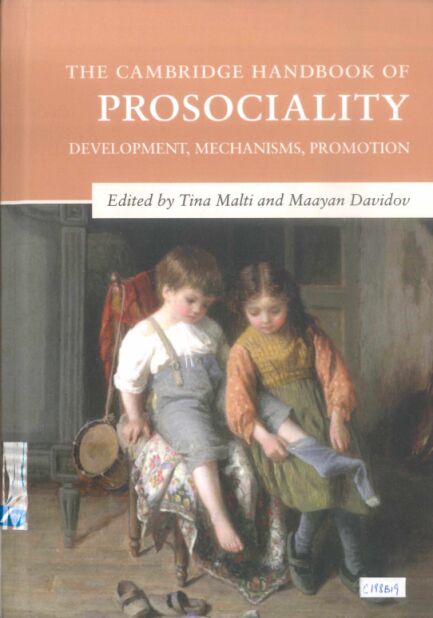
书名:The Cambridge handbook of prosociality
责任者:Tina Malti | Maayan Davidov.
ISBN\ISSN:9781108834711,9781108819763
出版时间:2023
出版社:Cambridge University Press,
分类号:社会科学总论
页数:xiii, 663 p.
摘要
Prosociality is a multifaceted concept referring to the many ways in which individuals care about and benefit others. Human prosociality is foundational to social harmony, happiness, and peace; it is therefore essential to understand its underpinnings, development, and cultivation. This handbook provides a state-of-the-art, in-depth account of scientific, theoretical, and practical knowledge regarding prosociality and its development. Its thirty chapters, written by international researchers in the field, elucidate key issues, including the development of prosociality across infancy, childhood, adolescence, and beyond; the biological, cognitive, emotional, and motivational mechanisms that underlie and influence prosociality; how different socialization agents and social contexts can affect children’s prosociality; and intervention approaches aimed at cultivating prosociality in children and adolescents. This knowledge can benefit researchers, students, practitioners, and policy makers seeking to nurture socially responsible, caring youth.
查看更多
目录
List of Figures page x
List of Contributors xi
Part I Development of Prosociality
1 Introduction: What Is Prosocial Development? Definition, History, Mechanisms 3
2 Developmental Theories of Prosociality 17
3 The Role of Genetics in the Development of Prosocial Behavior 37
4 Neurobiology of Prosociality: Investigating the Link between Empathy and Prosocial Behavior in the Brain 61
5 The Developmental Psychophysiology of Prosociality 85
6 The Origins of Prosociality from a Developmental and Comparative Perspective 108
7 Prosocial Behavior in Infancy and Early Childhood 127
8 Prosociality in Middle Childhood 145
9 Prosocial Behaviors in Adolescence 163
10 Prosocial Development across the Lifespan 189
Part II Antecedents and Mechanisms of Prosociality
11 The Motives of Prosocial Behavior 209
12 Morality, Values, and Prosociality across Development: Intertwined yet Distinct 233
13 Emotions and Prosociality 256
14 Social-Cognitive Development and Early Prosocial Behavior 275
15 Temperament and Prosocial Behavior 300
16 Gender and Prosocial Development 320
17 Assessing Prosociality: An Early Ontogeny Perspective 335
Part III Development of Prosociality in Context
18 Parenting and Children's Prosociality: Multiple Pathways to Socialization 361
19 Sibling Influences on Prosociality: From Infancy to Adolescence 388
20 Prosocial Behavior, Peer Relationships, and Friendships 409
21 Children's Intergroup Prosocial Behavior: The Role of Group Stereotypes 427
22 Prosocial Behavior in School Contexts 442
23 Community and Neighborhood Influences on Prosociality in Children and Youth 459
24 Culture and Prosociality 477
25 Prosocial Media N 501
Part IV Applications: Nurturing Prosociality
26 Fostering Prosociality in the Family Context: A Review of Parent-and Family-Focused Interventions Promoting Children's Effortful Control and Prosocial Tendencies 517
27 Prosociality and Civic Engagement 542
28 Prosocial Behavior, Positive Youth Development, and Character Virtues: A Dynamic, Relational Developmental Systems-Based Model 560
29 Relational Practices of Care to Nurture Prosociality and Advance Policy 577
30 Toward a New Era of Prosociality Research: Priorities, Challenges, and Possibilities 600
Afterword: A Reminiscence on Origins of Prosociality and Antisociality 614
Index 631
查看PDF
查看更多
馆藏单位
中国医科院医学信息研究所