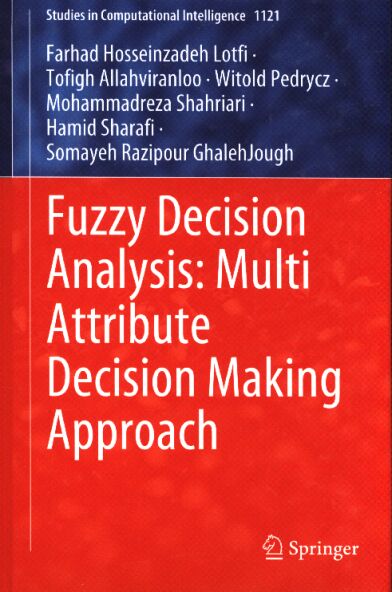
书名:Fuzzy decision analysis
责任者: Farhad Hosseinzadeh Lotfi ... [et al.] | Allahviranloo, Tofigh | Pedrycz, Witold
出版时间:2023
出版社:Springer Nature Switzerland AG
分类号:社会科学总论
页数:xxii, 344 p.
摘要
This book stands at the forefront of decision analysis, introducing the integration of fuzzy logic into multi-attribute decision-making. It is a transformative journey into the realm of advanced decision analysis. It book not only equips you with the knowledge to comprehend the theoretical underpinnings but also empowers you to apply these insights in practical scenarios. This book serves as your indispensable companion. Its comprehensive coverage serves as a beacon, guiding you through the intricate maze of fuzzy logic and multi-attribute decision-making, ultimately empowering you to embrace innovation and master the art of making well-informed decisions in an ever-changing world.
查看更多
目录
封面 1
目录 17
1 Foundations of Decision 23
1.1 Introduction 23
1.2 Decision Theory 24
1.3 Existential Philosophy of Decision Theory 24
1.4 Decision Science 26
1.5 The Importance and Applications of Decision Science 28
1.6 The Decision-Making Theories 29
1.7 The Reputable Domains and Applications of Decision Making 32
1.7.1 Decision Support Systems and Business Intelligence 32
1.7.2 Strategic Management 34
1.7.3 Healthcare and Medicine 35
1.7.4 Financial Decision-Making 36
1.7.5 Project Management and Scheduling 37
1.7.6 Environmental Planning and Management 38
1.7.7 Supply Chain and Operations Management 39
1.7.8 Engineering and Technology 40
1.7.9 Decision Making in Maintenance and Reliability 41
1.7.10 Human Resources and Talent Management 44
1.7.11 Crisis Management and Emergency Response 45
1.7.12 Public Policy and Governance 46
1.7.13 The Application of Decision Making Would Not End to Mentioned Area 47
1.8 The Reputable and Helpful Models and Techniques of Decision Making 48
1.8.1 Rational Decision-Making Model 49
1.8.2 Decision Trees 49
1.8.3 Cost-Benefit Analysis 50
1.8.4 SWOT Analysis 51
1.8.5 Pareto Analysis 52
1.8.6 Linear Programming (LP), Non-Linear Programming (NLP), and Integer Programming (IP) 53
1.8.7 Queuing Theory 54
1.8.8 Simulation Approaches 55
1.8.9 Data Envelopment Analysis (DEA) 56
1.9 The Hierarchy of Decisions 58
1.10 A Historical Review About Decision Making 59
1.11 Multi Attribute Decision Making (MADM) 66
1.11.1 Multi-Criteria Decision-Making Problems 67
1.11.2 Multi-Objective Decision-Making Problems 68
1.11.3 Design Models in Conditions of Uncertainty 68
1.12 Scale Measurements of Data 69
1.13 Qualitative Data and Ordinal Numbers 70
1.14 Quantitative Data and Cardinal Numbers 71
1.15 Scientometrics in the field of Fuzzy Multi Attribute Decision Making 72
1.16 Conclusion 75
References 76
2 Fuzzy Introductory Concepts 79
2.1 Introduction 79
2.2 Fuzzy Set Theory: Basic Concepts 80
2.3 Ranking of Fuzzy Numbers 88
2.3.1 Fuzzy Number Ranking Based on a-Cuts 88
2.3.2 Fuzzy Number Ranking Based on Hamming Distance 88
2.4 Type-2 Fuzzy Numbers 89
2.5 Type-2 Trapezoidal and Triangular Fuzzy Numbers 90
2.5.1 Arithmetic Operations on Type-2 Trapezoidal Fuzzy Numbers 93
2.5.2 Arithmetic Operations on Type-2 Triangular Fuzzy Numbers 94
2.6 Ranking of Type-2 Interval Fuzzy Numbers 95
2.6.1 Some Ranking Methods for Type-2 Interval Fuzzy Numbers 96
2.7 Conclusions 102
References 103
3 Weight Determination Methods in Fuzzy Environment 105
3.1 Introduction 105
3.2 Fuzzy Approximation Methods 105
3.2.1 Fuzzy Row Sum Method 106
3.2.2 Fuzzy Column Sum Method 107
3.2.3 Fuzzy Geometric Mean Method 108
3.3 Fuzzy Shannon Entropy Method 109
3.3.1 Shannon Entropy Method Using Triangular Fuzzy Number 112
3.4 Fuzzy Least Squares Method 113
3.5 BWM Method 116
3.5.1 Fuzzy BWM 118
3.6 Conclusion 121
References 121
4 Non-Compensatory Methods in Uncertainty Environment 123
4.1 Introduction: Non-Compensatory Fuzzy Methods 123
4.2 Fuzzy Lexicographic Method 124
4.3 Fuzzy Dominance Method 128
4.4 Fuzzy Max-Min Method 129
4.5 Fuzzy Conjunctive Satisfying Method 130
4.6 Fuzzy Disjunction Satisfying Method 133
4.7 Conclusion 136
References 137
5 Simple Additive Weighting (SAW) Method in Fuzzy Environment 139
5.1 Introduction 139
5.2 SAW Method 140
5.3 Choosing a Hospital Location 141
5.4 SAW Method in Imprecise Environments 143
5.5 Interval SAW 144
5.5.1 The First Approach of Interval SAW 144
5.5.2 The Second Approach of SAW-Interval Method 145
5.5.3 Application of Interval SAW Method 147
5.5.4 Fuzzy SAW 148
5.5.5 Fuzzy SAW Method with Predetermined Weights 151
5.5.6 Fuzzy SAW Method with Unknown Weights 152
5.5.7 Fuzzy SAW Application 156
5.6 Conclusion 160
References 161
6 Technique for Order Preferences by Similarity to Ideal Solutions (TOPSIS) in Uncertainty Environment 163
6.1 Introduction: The Essence of the TOPSIS Method and Its Application 163
6.2 Description of the TOPSIS Method 164
6.2.1 Case Study 167
6.3 Fuzzy TOPSIS Method Using Triangle Fuzzy Numbers 169
6.4 Group Fuzzy TOPSIS Method 172
6.5 Intuitionistic Fuzzy TOPSIS Group Decision Making Method 177
6.6 Applications 181
6.7 Fuzzy DEA-TOPSIS 194
6.8 Conclusion 198
References 199
7 Elimination Choice Translating Reality (ELECTRE) in Uncertainty Environment 201
7.1 Introducing Different Versions of the ELECTRE 201
7.2 Electre Ⅰ 202
7.3 Electre Ⅱ 206
7.4 Electre Ⅲ 207
7.5 Electre Ⅳ 209
7.6 ELECTRE I for Prioritizing Parks 210
7.7 Fuzzy ELECTRE Method 215
7.7.1 ELECTRE-Fuzzy Trapezoidal Form 216
7.7.2 Manager Selection: Employing ELECTRE Method and Fuzzy Linguistic Variables 220
7.8 The ELECTRE III Method and Interval-Valued Intuitionistic Fuzzy Sets 223
7.9 Unraveling Employee Commitment: Key Factors for Ranking and Evaluation Using the Interval-Valued Intuitionistic Fuzzy Number 230
7.10 Conclusion 231
References 236
8 Analytical Hierarchy Process (AHP) in Fuzzy Environment 237
8.1 Hierarchical Decision Structure (Threats and Opportunities) 237
8.2 Analytical Hierarchy Process (AHP) 239
8.3 Analytical Network Process (ANP) 244
8.4 Fuzzy AHP 246
8.4.1 Fuzzy AHP: First Approach 247
8.4.2 Fuzzy AHP: Second Approach 249
8.4.3 Fuzzy AHP: Third Approach 251
8.5 Fuzzy Analytic Network Process 252
8.6 Applications of Fuzzy AHP 253
8.7 Conclusion 258
References 258
9 VIKOR Method in Uncertainty Environment 261
9.1 Introduction 261
9.2 VIKOR 262
9.3 The Evaluation of Insurance Companies 264
9.4 Fuzzy VOKIR 267
9.5 Choosing a Suitable Tourism Location with Fuzzy VIKOR Method 270
9.6 Data Envelopment Analysis and VIKOR 275
9.7 Conclusion 276
References 277
10 The Measuring Attractiveness by a Categorical Based Evaluation Technique (MACBETH) in Uncertainty Environment 279
10.1 Introduction of the MACBETH method 279
10.2 Description of the MACBETH Method 280
10.2.1 Lp-Macbeth 281
10.3 Example of the MACBETH Method 282
10.4 The Fuzzy MACBETH Method: Introduction 285
10.5 Description of Fuzzy MACBETH Method 286
10.6 Applications and Example of the Fuzzy MACBETH Method 289
10.7 Macbeth and DEA 293
10.8 Conclusion 293
References 294
11 Multi Attributive Border Approximation Area Comparison (MABAC) in Uncertainty Environment 297
11.1 Introduction: The Power of MABAC 297
11.2 Description of the MABAC Method 298
11.3 Numerical Example of the MABAC Method 301
11.4 The Fuzzy MABAC Method 303
11.5 Applications and Example of the Fuzzy MABAC Method 307
11.6 Conclusion 310
References 310
12 The Complex Proportional Assessment (COPRAS) in Uncertainty Environment 313
12.1 Introduction 313
12.2 Description of the COPRAS Method 314
12.3 Solving Multi-Criteria Decision Making for Smart Phone Selection by COPRAS 316
12.4 Fuzzy COPRAS Method 317
12.5 Fuzzy COPRAS Approach Under Group Decision Making 322
12.6 Solving Investment Selection with Fuzzy COPRAS: Navigating Complex Criteria in Decision-Making 326
12.7 Conclusion 328
References 329
13 The Criteria Importance Through Inter-Criteria Correlation (CRITIC) in Uncertainty Environment 331
13.1 Introduction 331
13.2 CRITIC Method 332
13.3 Project Ranking: Evaluating and Prioritizing Projects Based on Criteria 334
13.4 Fuzzy CRITIC Method 336
13.5 Finding the Perfect Spot: Criteria for Selecting Optimal Locations for Solar Farm 340
13.6 Conclusion 345
References 346
14 The Multi-Objective Optimization Ratio Analysis (MOORA) in Uncertainty Environment 347
14.1 Introduction 347
14.2 The MOORA and MOOSRA Methods 348
14.3 Numerical Example of the MOORA Method 351
14.4 Fuzzy MULTIMOORA Method Using Triangular Fuzzy Number 355
14.5 Economic Ranking of Urban Areas Using MOORA Method: A Comprehensive Evaluation Approach 358
14.6 Conclusion 364
References 365
封底 367
查看PDF
查看更多
馆藏单位
中国科学技术信息研究所