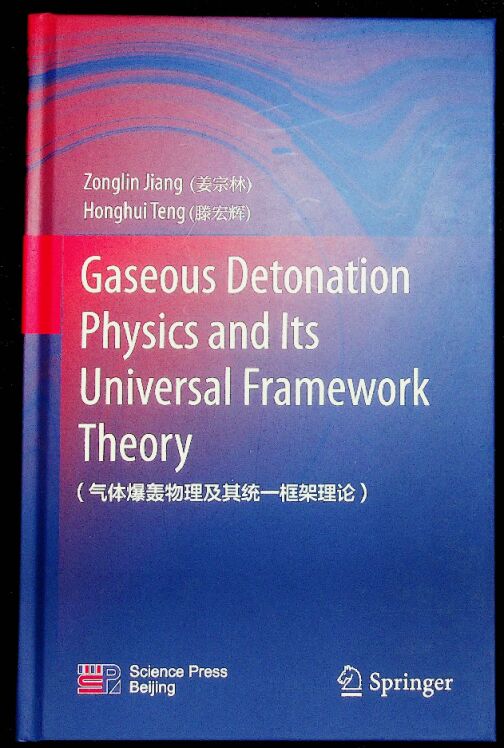
书名:Gaseous detonation physics and its universal framework theory
责任者:Zonglin Jiang | Honghui Teng = 气体爆轰物理及其统一框架理论 / 姜宗林 | 滕宏辉.
出版时间:2023
出版社:Science Press,
前言
This book introduces the research progress of gas detonation physics, and on this basis, a unified framework theory of gas detonation is proposed, and the framework theory is applied to guide the research of engineering-oriented detonation problems. The study of detonation waves has a history of more than 100 years, but theoretical research lags behind and experimental research methods are lacking. With the help of numerical simulation technology, which has developed rapidly in recent years, the author returned to the Institute of Mechanics of the Chinese Academy of Sciences from abroad in 1998 and led a team to carry out systematic research on the physics of gas detonation. This book systematically expounds the author's research achievements in detonation physics in recent years, summarizes the relevant achievements of other teams, and proposes a unified framework theory of gas detonation on this basis. This theory has been applied to the research of oblique detonation propulsion and detonation-driven shock wave wind tunnels, which has promoted the progress of engineering and the results obtained have also received extensive attention.
查看更多
目录
1 Introduction 1
1.1 Origin and Cognition of Gaseous Detonation 1
1.2 Explosion, Deflagration and Detonation Waves 2
1.3 Methodology of Gaseous Detonation Research 4
1.3.1 Experimental Research 4
1.3.2 Numerical Research 7
1.3.3 Detonation Theory 9
1.4 Critical Physical Phenomena of Gaseous Detonation 11
1.4.1 Detonation Initiation 11
1.4.2 Wave Structure 12
1.4.3 Detonation Quenching 13
1.4.4 Wave Evolution 14
1.4.5 Stability of Detonation Wave 16
1.4.6 Gaseous Detonation Application 17
1.4.7 Motivation of This Book 19
References 20
2 Mathematical Equations and Computational Methods 25
2.1 Fundamental Theories of Gaseous Detonation 25
2.1.1 Basic Equations 26
2.1.2 Rayleigh Lines and Hugoniot Curves 27
2.1.3 Chapman-Jouguet Theory 30
2.1.4 CJ Detonation Speed 33
2.2 Chemical Reaction Models 34
2.2.1 One-Step Irreversible Heat Release Model 36
2.2.2 Two-Step Induction-Reaction Model 36
2.2.3 Detailed Chemical Reaction Model 38
2.3 Computational Fluid Dynamics Methods 40
2.3.1 Governing Equations 40
2.3.2 Computational Methods 43
2.3.3 Acceleration Technologies of Detonation Simulation 46
2.4 Some Typical Simulation Results 47
2.5 Concluding Remarks 54
References 55
3 Classical Theory of Detonation Initiation and Dynamic Parameters 59
3.1 CJ Theory and ZND Model 59
3.2 Deflagration-to-Detonation Transition 70
3.3 Direct Initiation Through Strong Shock 74
3.4 Detonation Initiation Theory 80
3.5 Important Dynamic Parameters 86
3.6 Relation Among Different Dynamic Parameters 90
References 94
4 Unstable Frontal Structures and Propagation Mechanism 95
4.1 Multiwave Detonation Fronts 95
4.2 Structure Evolution from Nonequilibrium State 100
4.3 Reflection and Diffraction of Cellular Detonations 109
4.4 Cylindrical Expansion Detonations 117
4.5 Strongly Unstable Detonations 123
References .
5 Universal Framework for Gaseous Detonation Propagation and Initiation 135
5.1 Introduction 136
5.2 Mechanisms Underlying Hot Spot Initiation 138
5.3 Chemical Reaction Zone and Its Evolution 146
5.4 Critical Initiation State and Its Characteristics 152
5.5 Equilibrium Propagation State and Its Averaged Features 157
5.5.1 Mechanisms Underlying Detonation Cell Generation 158
5.5.2 Supercritical Detonation 161
5.5.3 Subcritical Detonation 163
5.6 Averaged Cell Size and Half-Cell Law 166
5.6.1 Cylindrically Propagating Detonation 166
5.6.2 Detonation Cell Bifurcation Mechanism 168
5.6.3 Half-Cell Rule of Detonation Propagation 170
5.7 Detonation Cell Correlation with Ignition Delay Time 172
5.7.1 Ignition Delay Time 172
5.7.2 Cell Size Correlation 175
5.7.3 Detonation Reaction Modeling 177
5.8 Applications of the Universal Framework 180
5.9 Remarks on the Universal Framework 184
References 184
6 Structures and Instability of Oblique Detonations 187
6.1 Conservation Laws and Polar Analysis of Oblique Detonations 187
6.2 Wave Structure of Initiation Region 191
6.3 Multiwave Structures on an Unstable Surface 198
6.4 Oblique Detonation Waves in Nonideal Inflow Conditions 208
6.5 Effects of Rear Expansion Waves Derived from Finite-Length Wedges 214
6.6 Effects of Blunt Body on Initiation 220
6.7 Remarks on Oblique Detonations 225
References 226
7 Engineering Application of Gaseous Detonations 229
7.1 Thermal Analysis of Detonation-Based Combustion Process 229
7.1.1 Thermal Cycle Efficiency for Isobaric Cycles 230
7.1.2 Thermal Cycle Efficiency for Isochoric Cycle 233
7.1.3 Thermal Cycle Efficiency for Detonation Cycle 236
7.1.4 Comparison of Thermal Cycle Efficiency for Isochoric, Isobaric and Detonative Engines 240
7.2 Propulsion Technology Based on Detonation Combustion 243
7.2.1 Pulse Detonation Propulsion Concept 245
7.2.2 Oblique Detonation Propulsion Concept 247
7.2.3 Rotating Detonation Propulsion Concept 252
7.2.4 Key Technologies for Detonation Engines 256
7.3 Shock Tunnel Driven by Gaseous Detonations 258
7.3.1 Principles of Detonation-Driving Shock Tube/Tunnel 260
7.3.2 Development of Detonation-Driving Shock Tunnel 262
7.3.3 Transient Testing Techniques in High-Enthalpy Shock Tunnels 267
References 270
查看PDF
查看更多
馆藏单位
中科院文献情报中心