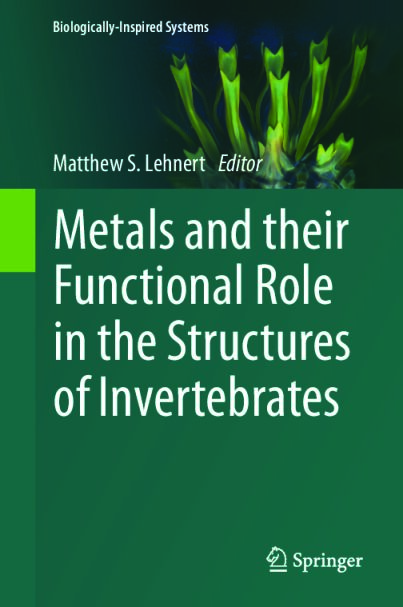
书名:Metals and their functional role in the structures of invertebrates
分类号:生物科学
页数:viii, 277 pages
摘要
The invertebrates comprise an enormous collection of diverse evolutionary lineages, consisting of unique species, some of which seem otherworldly. Indeed, invertebrates are an integral part of our lives, ranging from causing enormous human casualties (e.g., mosquito-transmitted diseases such as malaria) to providing pollination services and inspiration for science fiction stories. Although my interest in invertebrates (especially insects) and their evolutionary biology dates back to my childhood, it was through my professional studies with insect feeding mechanisms and mouthpart morphology that I was introduced to the adaptive role of metal-enriched cuticle. I now find myself captivated by this field, particularly because studies of metal-enriched cuticle are diverse and continue to inspire interesting questions that beckon for multidisciplinary collaboration. Although this field is not new, improvements in technology coupled with multidisciplinary partnerships have allowed us to address questions about metal-enriched cuticle that previously seemed unanswerable.
An association between invertebrates and metals is well known. The incorporation of metals into the exoskeletons of some invertebrates, for example, the calcium carbonate skeleton of crustaceans, is often mentioned in biology textbooks. In addition, other books are available that solely focus on the relationship between metals and invertebrates from the perspective of toxicology and residing in polluted environments. However, there are no books to date that focus exclusively on the adaptive value of having metal-enriched cuticle among the invertebrates. The collection of eight chapters presented in this book, authored by leaders in this field, provides an overview of how metal-enriched cuticle is adaptive among different invertebrate lineages. This book does not provide an all-encompassing synopsis of the entire field, but instead focuses on specific examples of metal-enriched cuticle among representative organisms of the major invertebrate phyla. The overarching aim of this book is to reveal the widespread and diverse uses of metal-enriched cuticle in the hope of inspiring students and professionals to pursue this field of research.
Chapter 1 delivers a general overview of metal-enriched cuticle in invertebrates and provides examples that include several of the major invertebrate phyla and gives suggestions for future studies. Chapter 2 reports experimental evidence as to why velvet ants are termed the “indestructible insects.” Importantly, this chapter (along with Chap. 3) provides details of the distribution of cuticular metals from several different body parts rather than focusing solely on a single structure. Chapter 3 reports the results from a comprehensive study of the elemental composition of the cuticle among cicada species. Here, data from previous publications of the cicada mouthparts and ovipositors are combined with new data acquired from other body parts to better understand how different transition metals and other inorganic elements are distributed along the body. Chapter 4 provides an interesting and unique example of the role of metals in invertebrates and explains how transition metals augment the glue of slugs, which is used for defensive purposes against predators. Chapter 5 reports the results of studies of metal-enriched cuticle using synchrotron X-ray tomography. The chapter highlights applications of this relatively new methodology that allows researchers not only the ability to identify specific elements in the cuticle, but, importantly, also provides a method to study the presence of metals deep into the structures rather than examining only the cuticle surface. Chapter 6 presents the results of a comprehensive study of the material and mechanical properties of the molluscan radulae. The authors here used several different techniques, including confocal microscopy and nanoindentation, to show that these structures represent some of the hardest cuticle among invertebrates and their adaptive role in feeding behaviors. Chapter 7 provides details of how transition metals are used in the byssus of mussels, a unique structure with possibly important applications for biomedical research. Chapter 8 focuses on microwear patterns in modern and fossil claws of the Florida stone crab. The study reveals that microwear scratches are likely acquired while the crabs are alive, not post-mortem, and shows that fossil claws retain evidence of biomineralization via calcification.
The editor thanks all the contributing authors for providing fantastic stories to this book, which I hope will further inspire studies in this field by future researchers. In addition, the book provides excellent examples of multidisciplinary research and includes expertise in invertebrate morphology, materials science, biomechanics, and biochemistry. The editor thanks Kendall O. Myers and Kristen E. Reiter for their valuable suggestions and edits to some of the chapter. Also, special thanks to my wife Valerie R. Kramer-Lehnert for her ongoing support and encouragement while working on this book project and my children, Logan, Harrison, and Henry for their infectious enthusiasm of the sciences that keeps the work fun. I especially want to thank Springer for their encouragement and endorsement to produce a book that focuses on this field.
查看更多
目录
1 Invertebrates Are Heavy Metal: An Overview of Armor, Weapons, and Other Cuticular Adaptations of Diverse Lineages [Matthew S. Lehnert] 1
2 The Metal-enriched Head Cuticle of Velvet Ants (Mutillidae): A New Special Feature of the “Indestructible Insects” [Carlo Polidori, Marcello Romano, and Federico Ronchetti] 27
3 The Presence and Distribution of Transition Metals and Other Inorganic Elements in the Cuticle of Cicadas (Hemiptera: Cicadidae) [Cynthia P. Perkovich, Bethany R. Haynes, Kristen E. Reiter, Gene Kritsky, and Matthew S. Lehnert] 45
4 Sticky, Tough, Fast-setting Glue: How Metal Ions Make Arion subfuscus Mucus into a Potent Defensive Secretion [Andrew M. Smith] 95
5 Element Sensitive Synchrotron-Based X-Ray Tomography as a Technique for Studying Transition Metals in the Cuticle of Insects [Oliver Betz, Andreas Dieterich, Peter Cloetens, Lars Koerner, and Matthew S. Lehnert] 115
6 Diversity of Mineral Systems, Material Compositions and Mechanical Properties in Molluscan Radulae [Wencke Krings and Stanislav N. Gorb] 173
7 Formation and Function of Metal Coordination Cross-Linking in Mytilus Mussel Byssus [Samantha Jee and Matthew J. Harrington] 215
8 Microwear Analysis and Functional Morphology of Claws of the Florida Stone Crab, Menippe mercenaria [Eric J. Sload, Rodney Feldmann, Matthew S. Lehnert, and Carrie Schweitzer] 257
查看PDF
查看更多
馆藏单位
中国农科院农业信息研究所